
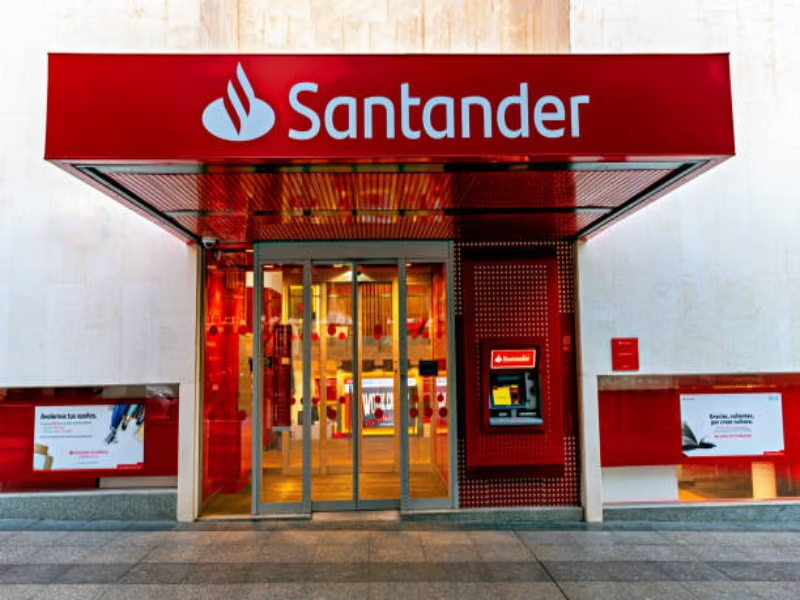
It was said on Tuesday that Spain’s Santander will acquire the U.S. regional lender Webster Financial in a $12.2 billion deal to form one of the top 10 retail and commercial banks in the country, marking a major bet on the U.S. market.
Santander, under Executive Chair Ana Botin, has put the U.S. at the centre of its strategy, in contrast to its European competitors, which in the last ten years have sold off or reduced their operations.
Botin is making it twice with a deal that will launch Santander skyrocket into the top 10 biggest retail and commercial banks in the U.S. based on assets, and a merged U.S. balance sheet of about 327 billion in assets. However, in the case of Santander, the U.S. listed stock decreased 6.4 percent to close at $12.23.
The Spanish bank, recently surpassing UBS of Switzerland to become the largest lender in Europe by market value, was first introduced in the United States with the purchase of Sovereign Bank in the year 2005 and is now among the largest players in the auto lending industry in the market.
The takeover threat posed by Wall Street banks and other big regional lenders has been on the rise in recent months under the administration of President Donald Trump, on the presumption that regulators will give approvals to deals that would have been foiled or refused by the past administration.
LSEG pointed out that the deal would be the largest banking takeover since October 2025, when Fifth Third Bank declared its $10.8 billion acquisition of Comerica Inc and HSBC declared its $13.6 billion acquisition of Hang Seng Bank.
Santander also ventured into the U.S. corporate and investment banking sector in 2023, when it employed over 100 employees of the collapsed bank Credit Suisse.
Botin reported that the strategically major acquisition of Webster Financial, based in Connecticut, would enable the bank to strengthen scale and profitability and lower funding costs. Therefore, it offered 2.0548 of its shares and $48.75 in cash for each Webster share. Botin stated that the bank was not considering raising the offer.
This deal, which also enables the lender to counter a portion of the pressure caused by reduced lending revenue, is likely to be closed in the second half of 2026. Botin stated that the bank had no further intentions of undertaking any additional bolt-on acquisitions in the next three years.
The acquisition will see Santander in a position to achieve a ratio of returns-on-tangible-equity of approximately 18 percent in the U.S. by 2028, one of the top five in terms of profitability among the 25 largest commercial banks in the U.S., and a target of over 20 percent by 2028 at the group level.
Santander sought to preserve all its shareholder remuneration commitments, such as the 5 billion euro ($5.91 billion) share buyback approved by the company on Tuesday and its promises to pay shareholders at least 10 billion euros against 2025 and 2026 results and to maintain a 50 percent payout ratio.
Santander indicated that the group CET1 ratio would be 12.8 percent at the end of the process, and the same is expected to be more than 13 percent by 2027.
That combination was also predicted to provide substantial combined cost synergies of approximately $800 million that is equal to approximately 19 percent of the combined basis of cost. Centerview Partners, Goldman Sachs, and Bank of America advised Santander on the deal.
Santander said on Tuesday that its net profit for 2025 would be increased by 12 percent to record 14.1 billion euros, much higher than its projection of 13.77 billion euros, and that its ROTE was to be 16.3 percent after AT-1 capital instruments, which was below its own 16.5 percent target at year-end 2025.
Santander anticipated its group net profit in 2026, assuming, without the agreed disposal of its Polish companies, the acquisition of the TSB unit in Britain, or the Webster acquisition, to keep increasing after 2025 profit and increase by 14-16 percent in 2027 in constant euros.
During the fourth quarter, net profit increased by 15 percent year-on-year with a record 3.76 billion euros, surpassing the forecast of 3.44 billion euros.
Its lending revenue, which was the amount of earnings earned on loans less the cost of deposits in 2025, decreased by 2.8 percent to 45.35 billion euros, a little more than 45.2 billion euros anticipated by analysts.