
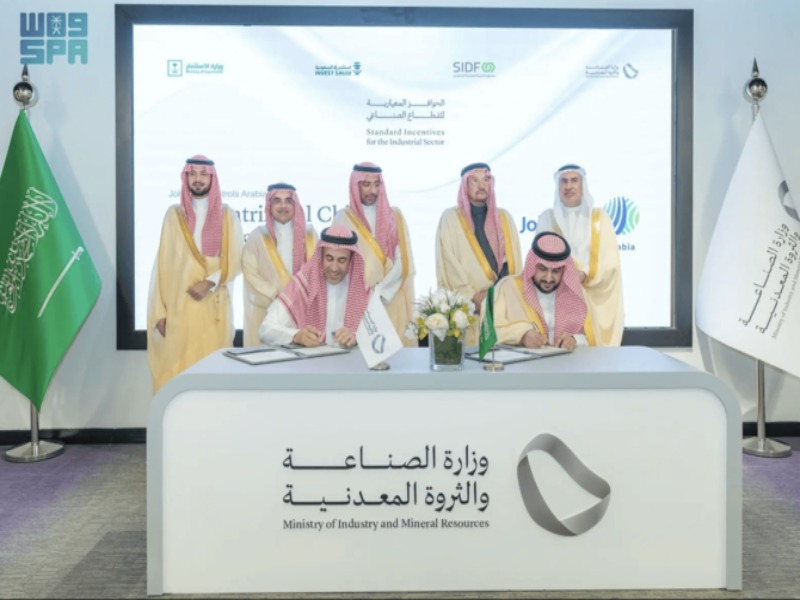
The Ministry of Industry and Mineral Resources of Saudi Arabia has signed agreements on nine projects that comprise the first group of beneficiaries of the standard incentives of the industrial sector, where the total amount of investment is approximately SR2 billion ($523 million).
This was done at a ceremony organized under the patronage and in the presence of the Minister of Industry and Mineral Resources, Bandar bin Ibrahim Alkhorayef, and the Minister of State, Member of the Council of Ministers, and Secretary of the Localization and Balance of Payments Committee, Hamad bin Mohammed Al-Sheikh.
The Saudi Press Agency reported that in his speech at the ceremony, Alkhorayef stated that the standard incentives program is one of the significant enablers for stimulating value-added industrial investments and empowering the manufacturing of new products.
This helps improve localization and create local content, and fulfills the goals of Saudi Vision 2030, which is to make industry one of the main sources of economic growth and diversify the production base in the Kingdom.
The minister also highlighted that standardized incentives represent a contemporary means of restructuring the bond between the government and industrial investors by increasing transparency and aligning government support with the real economic contribution of projects.
He remarked that three broad principles are the foundation of the program, and they include fairness and clarity, maximizing economic impact, and sustainability and accountability.
Another aspect that Alkhorayef emphasized is that the beneficiary projects are going to enhance the local content, the import substitution, as well as the growth in non-oil exports, not to mention the utilization of advanced technologies and sustainable production practices.
He confirmed that the signing of these contracts is the start of a long-term partnership between the government and investors. The minister urged the existing investors to present high-quality projects that would make the sector more competitive.
He also discussed a message to prospective national and international investors, that there are still opportunities to invest in industry within the Kingdom, and that standardized incentives will be offered to achieve their aspirations and decrease the risks associated with investments.
Besides nine contracts signed with beneficiaries of the first category of standard incentives, the ministry also gave out letters of intent to 25 projects in the second category that were qualified with total investments approaching SR5 billion.
The ministry declared that the program has had more than 500 applications to date, and it is still in the process of studying more than 300 more undertakings.
It anticipates that the overall worth of investments that will be gained under the program will reach about SR24 billion, with the outcome of such applications to be revealed in the coming years.
The standard incentives related to the industrial sector focus on empowering the private sector and making Saudi Arabia more appealing to high-tech and value-added industries.
They form a core component of the industrial empowerment system of up to 35 percent of the initial project investment, including a limit of SR50 million per qualified project, apportioned throughout the construction and production stages.
However, this guarantees sustainable growth in development and the growth and expansion of new industries of products.
Gradually, the first set of incentives was introduced in January by the Ministry of Industry and Mineral Resources and the Ministry of Investment and aimed at three strategic industrial areas: downstream chemicals, automotive manufacturing, and machinery and equipment.
It was succeeded by the release of the second set of incentives in June, comprising more sectors, including aviation, building materials, medical equipment, and pharmaceuticals, food processing, maritime industries, and mining.
This was to promote the growth of local content, improve the competitiveness of supply chains, and broaden the national industrial production base.