
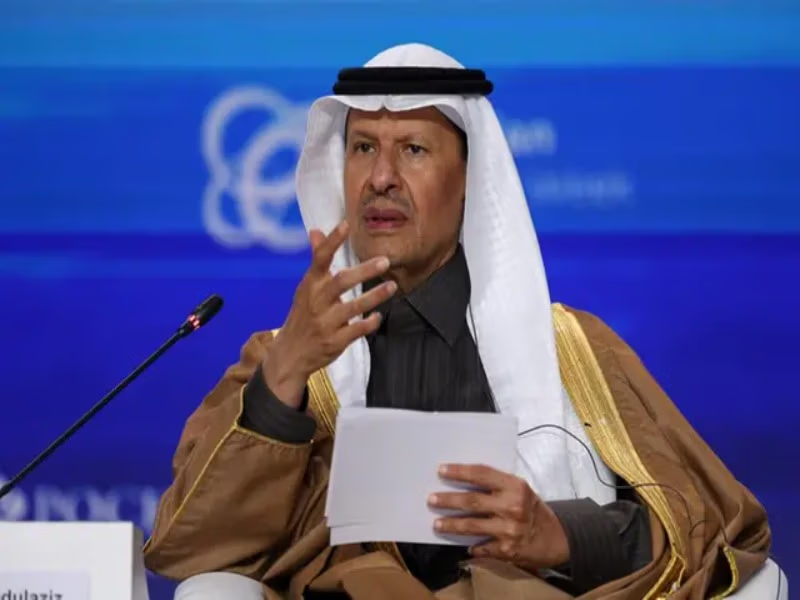
Saudi Energy Minister Prince Abdulaziz bin Salman Al Saud said on Monday that a new mechanism embraced by OPEC+ to assess members’ in evaluating the maximum production capacity of will eventually play a role in stabilizing markets and rewarding those who invest in production.
OPEC said on Sunday that the OPEC+ group ratified the mechanism to evaluate the maximum production capacity of the members to be employed in determining baselines from 2017, against which the members would base their output targets.
Prince Abdulaziz claimed that it was “fair and transparent” to set the levels of production. He stated that “Now we have the most detailed, the most technical, transparent approach of how we can move forward in the future in managing the market and how to attend to production.”
He reported during the launch of a Saudi-Russian business forum in Riyadh that “Yesterday was probably one of the most successful days in my personal career, and I am very grateful and thankful for the support of our friends in Russia.”
The Sunday meetings of OPEC+, which unites the Organization of the Petroleum Exporting Countries and its allies under the leadership of Russia, also decided to leave oil output levels unchanged in the first quarter of 2026.
As per the sources, following the meetings indicate that this is due to the planned evaluation of the members’ maximum production capacity that will be conducted between January and September 2026, and 2027 output quotas can be determined.
Prince Abdulaziz stated that “It will also be a mechanism that will reward those who invest and those who believe there is growth, and would put us in the lead amongst the other producers.”
The issue of production capacity and quotas has been the center of talks within OPEC+ over the years that have proved to be challenging, as some members, like the United Arab Emirates, have more capacity and would like to have higher quotas.
Other members, like the African countries, have experienced a reduction in production capacity, yet are opposing the decline in quota. Thus, Angola exited the group due to a dispute over its production quotas in 2024.