Japanese tech stocks plummeted on Thursday, as the AI infrastructure spending concerns on Wall Street surpassed the ocean into the Asian markets, with AI-related stocks down.
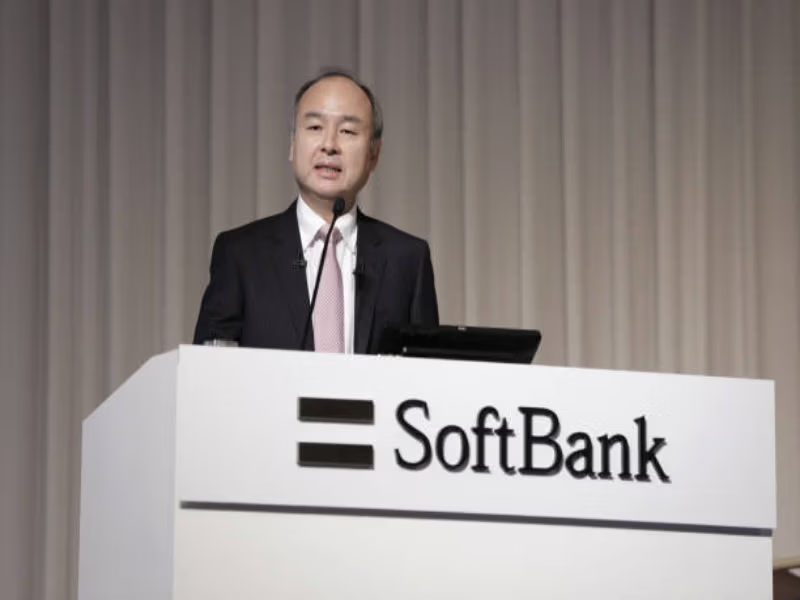
Softbank Group Corp was one of the biggest losers in the benchmark Nikkei 225, declining by up to 7.25 percent, and the index was the top loser in Asia, declining by 1.23 percent. The group had scaled down some of the losses and was trading down by the last 3 percent.
This drop follows the tech-heavy Nasdaq Composite dropping 1.81 percent overnight, pulled down by losses in Oracle, Broadcom, Nvidia, and other AI trades.
The declines in Oracle followed a Wednesday report by the Financial Times that the plans of Blue Owl Capital to fund the cloud infrastructure company $10 billion Michigan data center project had withdrawn.
However, the company had earlier refuted a report by stating that it had postponed some of its projects to AI giant OpenAI to 2028.
The tech-oriented SoftBank has experienced a rapid fluctuation in its share price within the last month amid the panic about AI-related spending in the market.
The group had announced it was planning to pour $500 billion in AI infrastructure in the U.S., and with OpenAI, Oracle, and other partners, and in September, it declared five additional AI data centers in the U.S. as part of Stargate, the OpenAI general AI infrastructure.
Therefore, other Japanese technological stocks declined as well. Semiconductor equipment supplier Advantest fell as much as 5 percent. Its counterparts, Lasertec, Renesas Electronics, and Tokyo Electron, declined between 3 percent and 4 percent.
Expert director at Tokyo-based financial services firm Monex Group, Jesper Koll, stated that much is made in Japan that is put in data centers, power centers, and AI hardware enablers is “Made in Japan, and can only be made in Japan.”
That indicates Japanese tech, especially AI-related stocks, is more vulnerable to any concerns around U.S. tech spending. The trade data of Japan released on Wednesday indicated that Japan recorded a 7.4 percent leap in the trade of electrical machinery, and 13 percent year-on-year growth in semiconductor-related trade.
Koll claimed that the boom in tech expenditure led by the U.S. was converting into the increasing exports of specialized machinery and equipment.
South Korean chip heavyweight Samsung Electronics experienced a slight decline of 0.93 percent, while SK Hynix reversed course to gain 0.73 percent. Taiwan’s TSMC, the world’s biggest contract chip manufacturer, was slightly down.