
South Korean shares of automobile firms climbed on Tuesday following the announcement by U.S Secretary of Commerce Howard Lutnick that the reduction of U.S auto tariffs by 15 percent on South Korea would be effective from November 1.
As per the X (formerly known as Twitter) post by the U.S. Department of Commerce, Lutnick said that “We are also removing tariffs on airplane parts and will ‘un-stack’ Korea’s reciprocal rate to match Japan and the EU.”
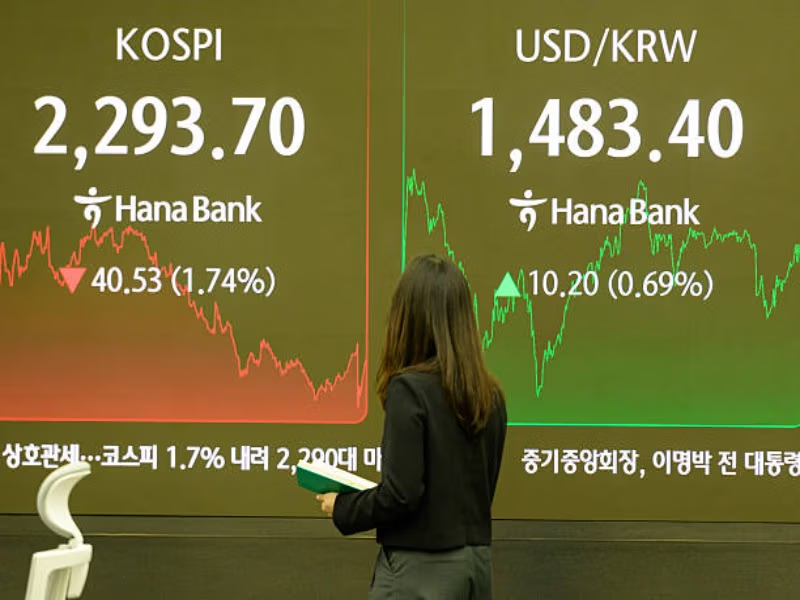
Car companies like Hyundai Motor and Kia Corp increased by almost 5 percent and 3 percent, respectively. The Kospi of South Korea rose 1.02 percent, and the small-cap Kosdaq fell 0.13 percent.
According to government data released on Tuesday, the headline inflation in South Korea increased 2.4 percent year-over-year in November, higher than the 2.35 percent growth that economists had projected in a Reuters poll. However, core inflation, which eliminates prices of fresh food and energy, increased 2 percent compared to the previous year.
The most recent figure remains the same as the inflation rate in October, which suggests that the central bank should maintain interest rates. The Bank of Korea had maintained the rates on a fourth consecutive meeting at 2.5 percent last Thursday.
The benchmark indexes in the wider Asia-Pacific region generally rose on Tuesday, following a Wall Street decline as the crypto sell-off undermined market sentiment.
Bitcoin dropped approximately 6 percent overnight to trade below $86,000, draining investor confidence and weighing on the stock market. It was trading at $86,866.49 as of 9:30 a.m. on Tuesday (8:30 p.m. ET Monday) Singapore time.
The digital currency has been having a hard time remaining above $90,000, as it has dropped below that point late last month in the first time that it has done so since April. Therefore, other crypto-related equities such as Coinbase and Strategy lost out this Monday, during trading hours in the U.S.
AI-related shares, Broadcom and Super Micro Computer, lost more than 4 percent and 1 percent, respectively, resulting in more profit-taking in the sector.
Japan’s benchmark Nikkei 225 index rose by 0.54 percent, and the Topix index improved by 0.44 percent. The financials, energy, and basic materials sectors had gains on the index.
However, the top movers on the Nikkei 225 were industrial robot maker Fanuc, which had increased 5.86 percent. NGK Insulators, which manufactures diesel particulate filters, improved by up to 6 percent, and Fujikura Electrical equipment firm gained 2.29 percent.
The Japanese benchmark Nikkei 225 index rose by 0.54 percent, and the Topix index improved by 0.44 percent. The financials, energy, and basic materials sectors had gains on the index.
Meanwhile, yield on the 20-year JGB increased to 2.915 percent, typically the highest level since 1999, and yield on the 30-year JGB increased to an all-time high of 3.411 percent.
Similarly, Australia’s ASX/S&P 200 surged up to 0.12 percent. The Hang Seng Index of Hong Kong was up 0.49 percent at the start, but the mainland China CSI 300 was down 0.17 percent.
The Alibaba Group stocks gained almost 3 percent in Hong Kong, continuing a three-day streak, as the tech giant unveiled its Quark artificial intelligence glasses in China on November 27.
The equity futures in the U.S. remained not far apart in the early Asian markets following the five consecutive days of gain streaks broken by all three major benchmarks.
The S&P 500 fell by 0.53 percent to close at 6,812.63, and the Nasdaq Composite declined by 0.38 percent to close at 23,275.92 overnight. The Dow Jones Industrial Average rallied by 427.09 points, or 0.9 percent, to settle at 47,289.33.