
Stocks improved on Friday following the Supreme Court decision to oppose the tariffs imposed by President Donald Trump, which could have relieved companies caught in the high expense of the duties and relieved the worry about tenacious inflation that has continued to trouble the U.S. economy.
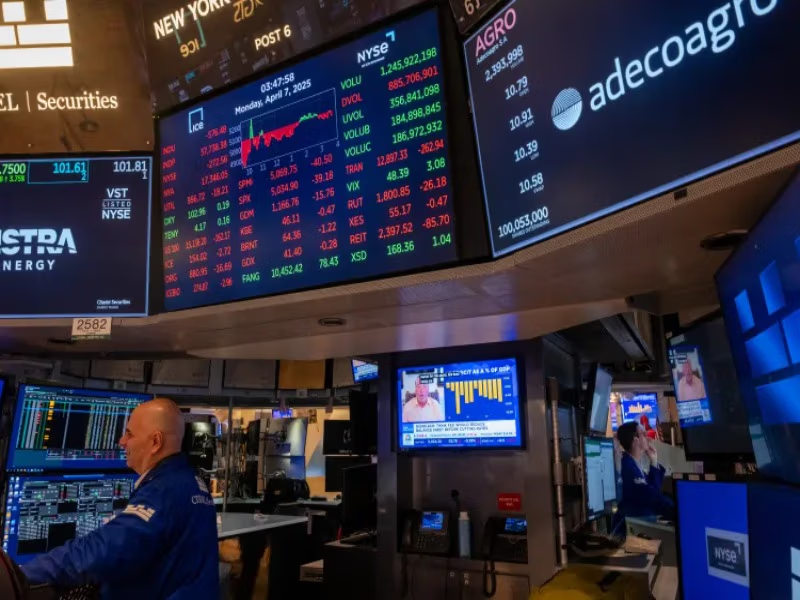
The S&P 500 increased 0.69 percent and ended at 6,909.51, while the Nasdaq Composite gained 0.9 percent and settled at 22,886.07. The Dow Jones Industrial Average gained 230.81 points, or 0.47 percent, and ended at 49,625.97. The 30-stock index rebounded from a 200-point loss earlier in the session on disappointing economic data.
The Supreme Court invalidated the vast majority of Trump’s broad tariff policy under the International Emergency Economic Powers Act, with the majority declaring that the law “does not authorize the President to impose tariffs.” However, Trump responded by declaring that he will put a new “global tariff” of 10 percent.
The president stated in a press briefing at the White House following the high court’s decision, “Now I’m going to go in a different direction, probably the direction that I should have gone the first time. I’ll go the way I could have gone originally, which is even stronger than our original choice.”
Shares of “Magnificent Seven” member Amazon, which sources up to 70 percent of its goods from China, per Wedbush Securities, already started to feel the effects of tariffs by raising the price of some of its goods as a result of the ruling, increasing by over 2 percent. Others expected to benefit from the outcome were higher as well, such as Home Depot.
Jed Ellerbroek, Portfolio Manager at Argent Capital Management, said, “In the case of Amazon specifically, a lot of their stuff is imported from China, so tariffs are going to make the prices on Amazon go up for customers, and when prices go up, people buy fewer of those things. No longer facing that problem is the source of excitement, I think.”
Although the reapproach of the Supreme Court was not much unexpected by Wall Street, certain questions have come up, such as whether one is going to be entitled to pay back the tariffs that were being paid at the higher rates. The Supreme Court decision did not comment on the issue.
FBB Capital Partners Senior Research Analyst and Asset Allocation Strategist, Michael Brenner, added, “Now lower courts are going to have to figure out what’s going to happen to people who paid the tariffs and the government paying out big refunds. If that’s out there, that would be effectively a form of economic stimulus.”
Traders were earlier in the day given a pessimistic outlook on the growth of the U.S. economy, with gross domestic product growing by 1.4 percent in the fourth quarter. This was lower than the 2.5 percent increase that was expected by the economists interviewed by Dow Jones. The third quarter improvement of 4.4 percent was a significant improvement over the estimates.
The government shutdown could be termed as record-breaking, which can be attributed in large part to the government. The department estimated that the stoppage, which occurred during the first half of the fourth quarter, removed approximately 1 percentage point of economic growth.
Besides the GDP data, the personal consumption expenditure price index report, which is a favorable inflation indicator of the Federal Reserve, indicated that inflation remained constant in December.
Core PCE, excluding volatile prices of food and energy, stood at 3 percent, as expected, but still far above the 2 percent inflation target set by the Fed.
Dow increased by 0.3 percent on the week with the shift on Friday. The S&P 500 surged 1.1 percent, and the tech-heavy Nasdaq snapped a five-week losing streak, gaining 1.5 percent.