

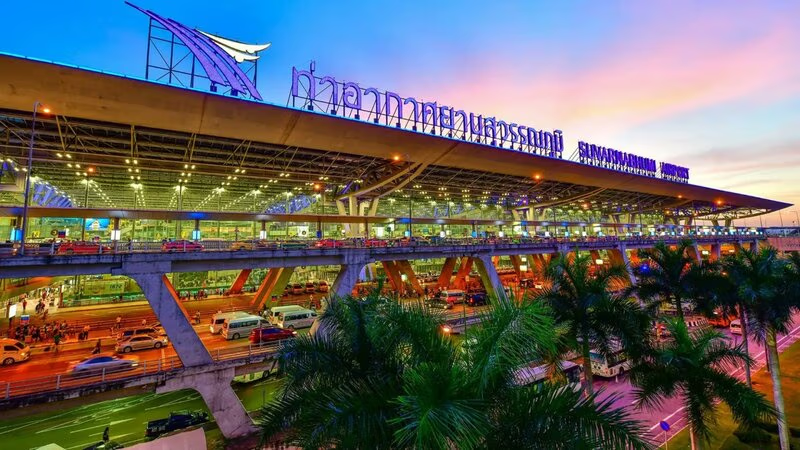
International travel to Thailand will become more expensive from June 20, after Airports of Thailand confirmed a 53 percent increase in passenger service charges for outbound international travellers.
The charge will rise from 730 baht to 1,120 baht per passenger, approximately $20.60 to $31.55.
The revised fee will apply at six major airports operated by Airports of Thailand: Suvarnabhumi, Don Mueang, Phuket, Hat Yai, Chiang Mai, and Chiang Rai. The domestic passenger service charge will remain unchanged at 130 baht, or about $3.65.
The increase was approved by the Civil Aviation Board in December 2025 and forms part of a broader strategy to strengthen airport infrastructure and long-term financial sustainability.
Revenue Impact And Expansion Plans
Airports of Thailand expects the higher charge to generate an additional 13 billion baht in fiscal year 2027, equivalent to roughly $366 million.
The additional revenue will help fund major expansion projects, including the construction of a new South Terminal at Suvarnabhumi Airport. The project is estimated to cost more than 200 billion baht, or approximately $5.63 billion.
The airport operator has stated that the increase is intended to reinforce its financial position by strengthening its cost structure, reducing borrowing requirements, and easing interest burdens. Officials maintain that the passenger service charge accounts for only a small portion of total airfare costs and is unlikely to materially affect long-haul travel demand.
Thailand is among the relatively few countries that levy service charges only on departing passengers. In many major aviation markets, both departing and transit passengers are charged, providing airports with a broader and more stable revenue base.
Tourism And Competitiveness Considerations
While the increase amounts to roughly $11 per departing passenger, the relative impact may vary by route. On short-haul and low-cost regional flights priced between 4,000 and 5,000 baht, or approximately $113 to $141, the higher service charge could raise overall ticket costs by a noticeable percentage.
Comparisons are also being made with other global aviation hubs in Asia and the Middle East, including Singapore Changi, Doha Hamad, Tokyo Haneda, Seoul Incheon, and Hong Kong International Airport. Although several of these airports impose higher total fees, they consistently rank among the world’s top airports for service quality and operational efficiency.
Industry observers note that the long-term effect on Thailand’s tourism competitiveness will depend on whether the additional revenue translates into visible improvements. Faster immigration clearance, shorter security queues, improved baggage handling systems, expanded seating capacity, and enhanced digital infrastructure are likely to be key indicators for travellers and airlines.
Balancing Growth With Infrastructure Needs
Passenger volumes at Thailand’s main international gateway, Suvarnabhumi Airport, have risen steadily in recent years, placing pressure on capacity and operational efficiency. Expansion is widely viewed as necessary to sustain growth and maintain the country’s status as a regional aviation hub.
The revised passenger service charge reflects a balancing act between financing large-scale infrastructure upgrades and preserving Thailand’s price competitiveness in an increasingly competitive global tourism market.
As the June implementation date approaches, airlines, travel operators, and international travellers will closely assess whether the higher charge supports meaningful improvements while keeping Thailand attractive as a global destination.