

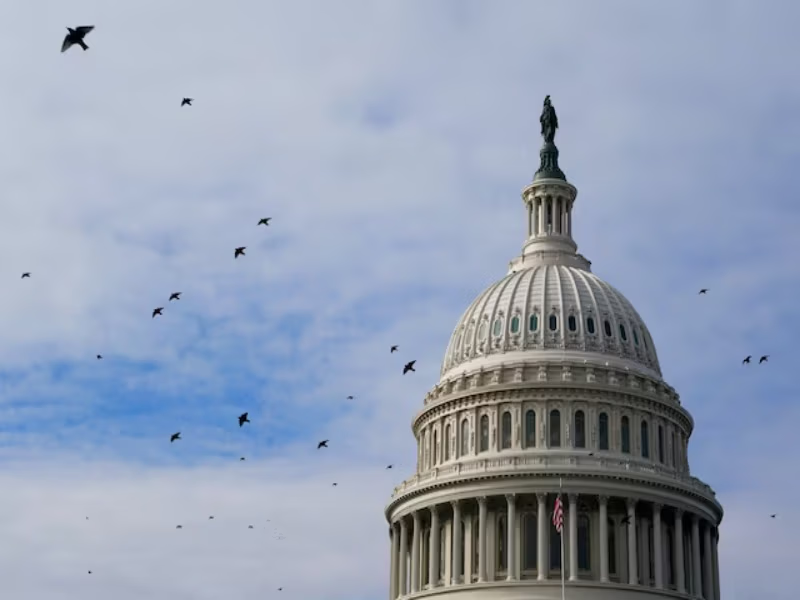
According to the officials and documents reviewed by Reuters, the Trump administration and the U.S. Congress are introducing a plan this week to overturn a mining ban by former President Joe Biden in northern Minnesota and prohibit similar actions by future administrations.
The decision has been prepared over much of the last year and entails a complicated set of legislative procedures that will advantage the project of Twin Metals, copper, cobalt, and nickel of Antofagasta, one of North America’s largest untapped reserves of those critical minerals. The specifics of the plan have not reported yet.
It is a kind of refocus on U.S. domestic mining projects by Trump, although his administration still tries to win access to the minerals in Greenland, Ukraine, and elsewhere.
The Minnesota plan is practically bound to raise the tensions on where and how to acquire minerals, such as those that the electrified economy and national security depend upon. The electric vehicles and AI data centers, as well as wind turbines, weaponry, and hundreds of other devices, are built using copper, nickel, and cobalt.
Biden prohibited mining on 225,504 acres in 2023 of the Superior National Forest within 20 years based on environmental protection purposes and an opinion that the economic value of the region would be better served through recreational use rather than mining.
The mining ban was registered in the Federal Register, where the executive branch monitors action, but not the Congressional Record, where legislative actions are also recorded and provide formal notice to Congress.
Under a 1976 law referred to as the Federal Lands Policy and Management Act, the president is required to notify Congress of public land orders that affect more than 5,000 acres.
Since Biden failed to file the notice in the Congressional Record, the Interior Department under Trump is now doing the same with the hope that it will be rejected by Congress.
However, the Interior Department had alerted the U.S. House of Representatives earlier this week. The notice was subsequently referred to Vice President JD Vance, who leads the U.S. Senate, and is being reviewed by the U.S. Senate parliamentarian.
With the approval of the parliamentarian, which is likely by Friday, the Congress would have 60 days to approve or disapprove the plan using a simple majority. That vote would not be subject to a filibuster.
Minnesota Republican Congressperson Pete Stauber, who represents the northern part of Minnesota, has outlined plans to introduce a bill by Friday, seeking to reject the mining ban.
With Congress and Trump on board, as is unlikely in the Republican-controlled Congress, a future president would not be able to recreate the ban of Biden due to a clause in the 1996 Congressional Review Act.
Save the Boundary Waters, a conservation group, claimed that Stauber was taking an unprecedented tactic in an effort to coerce the mine into approval.
Group’s Executive Director, Ingrid Lyons, said, “And for what? To benefit a Chilean mining company that sends its minerals to China will destroy America’s most visited wilderness area and leave the mess up to the American and Minnesota taxpayers.”
Congressional staffers stated that the complicated legislative agenda was assembled following the failure to incorporate the measure into Trump’s One Big Beautiful Bill, which was signed into law last July.
Stauber, Chair of the U.S. House Subcommittee on Energy and Mineral Resources, informed Reuters that “We have industries here in our country that need these critical minerals. We must never rely on foreign adversaries like China for supply.”
The White House was not immediately available to comment. In case the mining ban is removed, then the Trump administration would be clear to grant mining leases to the Chile-based Antofagasta, which has been struggling to develop the mine for decades on land under the control of the federal government.
The mine would also have to be subjected to environmental review and be issued permits. Stauber reported that the Trump administration has informed him that it is reviewing the reissuance of the leases, though he did not get any more information.
Antofagasta’s Twin Metals unit said it expects to get the leases back in the near future and that it is “very appreciative of Congress for their efforts to overturn an unnecessary and detrimental action that locked out a significant domestic source of critical minerals.”
The leases themselves have been a political hot potato since the time they were first issued in 1966. These were blocked by former President Barack Obama as they were reissued in his first term before Trump reissued them, but they were canceled by Biden. No mining has been carried out at the site.
An underground mine in the Twin Metals would, assuming construction, provide a significant U.S. supply of copper, cobalt, and nickel. The sole surviving U.S. nickel mine will be closed later this decade.
Over 150,000 outdoor enthusiasts visit the region annually and have long feared that any disaster at the mines would contaminate rivers and be rapidly transported throughout the 1.1 million acres of the Boundary Waters Canoe Area Wilderness and into the Great Lakes.
Thus, Antofagasta has been saying that it would apply the most up-to-date equipment to conserve the environment.