
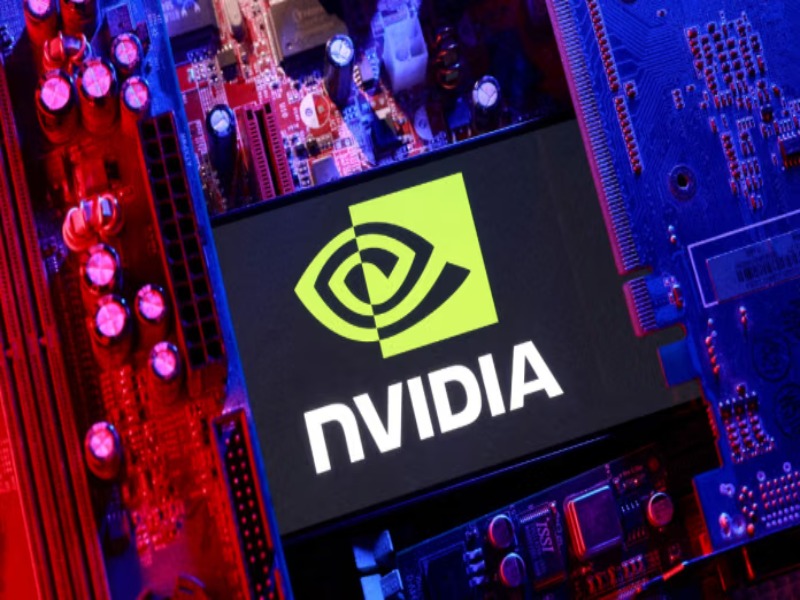
President Donald Trump announced on Wednesday that his administration will approve China’s sales of Nvidia’s H200 chip for artificial intelligence, the U.S. government would take 25 percent of sales, a day after the official regulations were posted by the U.S government.
Nvidia’s previous China-focused chip, the H20, the H200, is a version of the company’s Hopper generation that is also sold in the U.S. and in other markets. H200 was not particularly export-oriented and was slowed down.
In comments on Wednesday, Trump said that the performance of the H200 was surpassed by two generations of Nvidia chips in production now, referencing Nvidia Blackwell and Rubin artificial intelligence chips.
Trump said, “It’s not the highest level, but it’s a pretty good level, and China wants them and other people want them, and we’re going to be making 25% on the sale of those chips, basically.”
However, Trump first stated that the approval of H200 chips and the 25 percent government reduction a month ago. Earlier, Nvidia had indicated that the Chinese market had the potential of being worth of $50 billion per year.
Trump added, “We’re allowing them to do it, but the United States is getting 25% of the chips, in terms of the dollar value.”
In a filing on Tuesday, the Department of Commerce announced that the rule change involved certain conditions, such as that the exporter must certify that there is enough supply of the H200 chips in the U.S., and that the chips will not demand global foundry resources that could otherwise be used on more sophisticated AI chips destined to be sold in the U.S.
The government indicated that the chips would be required to have enough security measures taken by the customers, and the chips would have to be tested by an independent third party in the United States to ascertain their requirements before their shipment.
Therefore, the number of chips to be shipped to China would be limited to half of the overall product shipped to U.S. consumers. The filing also mentions AMD’s MI325X chip.
Nvidia spokesperson said in a statement, “We applaud President Trump’s decision to allow America’s chip industry to compete to support high-paying jobs and manufacturing in America. Offering H200 to approved commercial customers, vetted by the Department of Commerce, strikes a thoughtful balance that is great for America.”
The spokesperson mentioned, “The Administration’s critics are unintentionally promoting the interests of foreign competitors on U.S. entity lists — America should always want its industry to compete for vetted and approved commercial business, supporting real jobs for real Americans.”
Nvidia CEO Jensen Huang told reporters last week that the company is experiencing “very high” demand in China for the H200 chip and that the company had begun manufacturing the chip once again.
At the CES conference in Las Vegas, Huang added that ″We’ve fired up our supply chain, and H200s are flowing through the line.”
It remains uncertain whether the Chinese authorities will accept the importation of the Nvidia chips, since the nation is trying to push home-made inferior but superior AI chips to become self-reliant. Huang told him last week that he was not expecting a Chinese announcement.
Huang reported, “We’re not expecting any press releases or any large declarations. It’s just going to be purchase orders.”
Huang made a two-year projection of the sales of AI chips of half a trillion by the close of 2026, last year. He stated last week that the H200 sales to China would be in addition to that forecast.
The White House announced on Wednesday that it had also placed a 25 percent tariff on imports of several chips, such as H200, that must be imported to the U.S. to be examined before they can be shipped to China.