
U.S. President Donald Trump has indicated that diplomatic engagement with Iran may be underway, even as he escalated rhetoric by warning of potential military strikes targeting the country’s critical energy infrastructure if negotiations fail to yield results.
Speaking amid heightened geopolitical tensions, Trump said discussions were taking place with what he described as a “new and more reasonable regime” in Iran, suggesting a possible opening for de-escalation. At the same time, he cautioned that failure to reach an agreement could prompt strikes on key assets, including oil facilities, power plants, and Kharg Island, the primary hub for Iran’s crude exports.
The dual messaging reflects a strategy that blends diplomatic overtures with explicit military pressure, a combination that has amplified uncertainty across global markets already sensitive to developments in the Middle East.
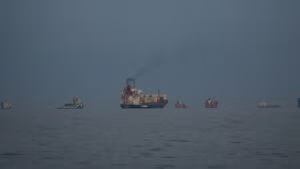
Energy markets have responded swiftly. Oil prices have surged above $114 per barrel as traders factor in the risk of supply disruptions in one of the world’s most critical energy corridors. The region’s strategic importance is underscored by its proximity to key shipping routes, such as the Strait of Hormuz, through which a significant share of global crude supply passes.
Any disruption to infrastructure or transit routes could tighten supply conditions sharply, intensifying inflationary pressures for energy-importing economies and adding volatility to financial markets.
Kharg Island has emerged as a focal point in the escalating rhetoric due to its outsized role in Iran’s oil exports. As the country’s main export terminal, it represents both a critical economic asset and a potential strategic vulnerability. Analysts note that any direct action targeting the facility would have immediate global repercussions, potentially triggering a spike in oil prices and broader economic fallout.
Despite the heightened tone, the prospect of negotiations introduces uncertainty about the conflict’s trajectory. Iranian officials have not fully aligned with the narrative of active talks, highlighting a disconnect that underscores the fragile nature of the current situation.
The broader implications extend beyond the region. With global markets already grappling with inflationary pressures and tightening financial conditions, further escalation could exacerbate existing economic challenges. Rising energy costs, coupled with geopolitical risk, have already begun to weigh on equities and currencies across emerging markets.
For policymakers and investors, the developments illustrate the increasingly direct link between geopolitical signals and market outcomes. As diplomatic efforts continue alongside military posturing, the balance between escalation and resolution will remain a key determinant of both regional stability and the global economic outlook.