

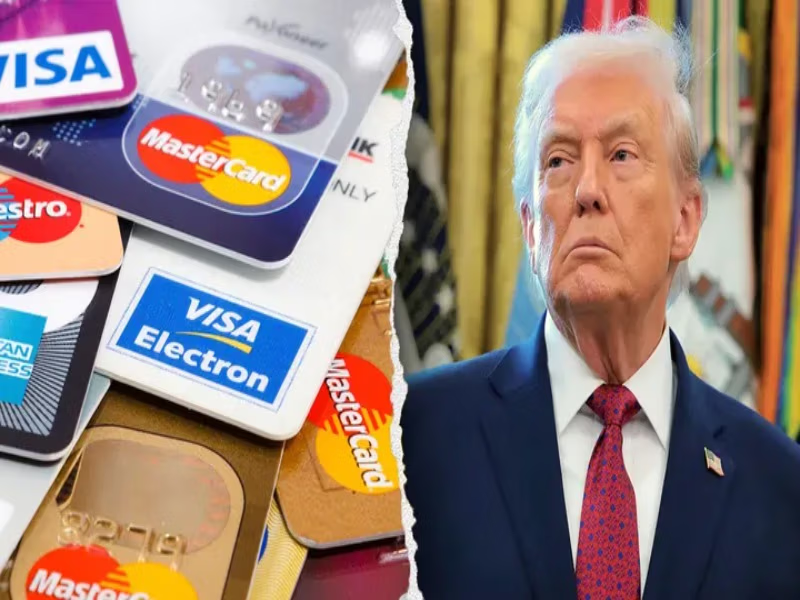
Donald Trump declared a one-year credit limit, restricting interest rates on credit cards to 10 percent this week, which has also elicited mixed responses among lawmakers and others.
The president’s social media post on Friday night said the restriction would be effective on January 20, but he did not specify how the government would enforce it or how companies would be held accountable.
Trump wrote in a Truth Social post that “Please be informed that we will no longer let the American Public be ‘ripped off’ by Credit Card Companies that are charging Interest Rates of 20 to 30%, and even more, which festered unimpeded during the Sleepy Joe Biden Administration.”
He stated that “Coincidentally, the January 20th date will coincide with the one-year anniversary of the historic and very successful Trump Administration.”
In his second campaign, Trump had promised to impose such a limit, with the American credit card debt reaching an unprecedented high of over $1.1 trillion. That debt would subsequently increase to an astonishing $1.17 trillion in the third quarter of 2024, up by $770 billion in the first quarter of 2021.
Senators Bernie Sanders and Josh Hawley later introduced a bipartisan bill in February 2025 to limit interest rates on credit cards to 10 percent within five years due to a lack of action on that campaign pledge.
In a statement announcing the bill, the lawmakers wrote that “When large financial institutions charge over 25 percent interest on credit cards, they are not engaged in the business of making credit available. They are engaged in extortion and loan sharking. We cannot continue to allow big banks to make huge profits, ripping off the American people. This legislation will provide working families struggling to pay their bills with desperately needed financial relief.”
However, the bill has not made any advancement in Congress, with strong opposition from the banking circles. A day before Trump’s announcement, Sanders criticized Trump for not fulfilling his campaign pledge.
Sanders wrote on X (formerly known as Twitter) on Friday, “Trump promised to cap credit card interest rates at 10% and stop Wall Street from getting away with murder. Instead, he deregulated big banks, charging up to 30% interest on credit cards.”
The announcement was made by the president hours later, which was pushed back by a billionaire hedge fund manager and Trump supporter, Bill Ackman.
Ackman posted, then deleted, a tweet that called Trump’s announcement “a mistake” and warned that credit card lenders could cancel consumer cards if they couldn’t charge rates “adequate enough to cover losses and to earn an adequate return on equity.”
Ackman posted on X on Saturday that “I think President @realDonaldTrump’s goal of reducing credit card interest rates is a worthy and important one. My concern about capping rates at 10% is that doing so will inevitably cause millions of Americans to have their cards cancelled as credit card companies lose the ability to adequately price subprime credit risk.”
Another senator, Elizabeth Warren, the Massachusetts representative, also showed doubts as to whether Trump could just enact such a cap without Congressional consent.
In a statement, Warren said, “Begging credit card companies to play nice is a joke. I said a year ago if Trump was serious, I’d work to pass a bill to cap rates.”
He added that “Since then, he’s done nothing but try to shut down the [Consumer Financial Protection Bureau]. Trump doesn’t care about affordability. Americans know a fraud when they see one.”
Similar to the reaction to the Sanders and Hawley bills, further opposition was voiced by the Bank Policy Institute, the American Bankers Association, the Consumer Bankers Association, the Financial Services Forum, and the Independent Community Bankers of America.
They issued a joint statement regarding the announcement: “We share the President’s goal of helping Americans access more affordable credit. At the same time, evidence shows that a 10% interest rate cap would reduce credit availability and be devastating for millions of American families and small business owners who rely on and value their credit cards, the very consumers this proposal intends to help. If enacted, this cap would only drive consumers toward less regulated, more costly alternatives. We look forward to working with the administration to ensure Americans have access to the credit they need.”
Hawley, on the contrary, praised the move and posted on X: “Fantastic idea. Can’t wait to vote for this.”