

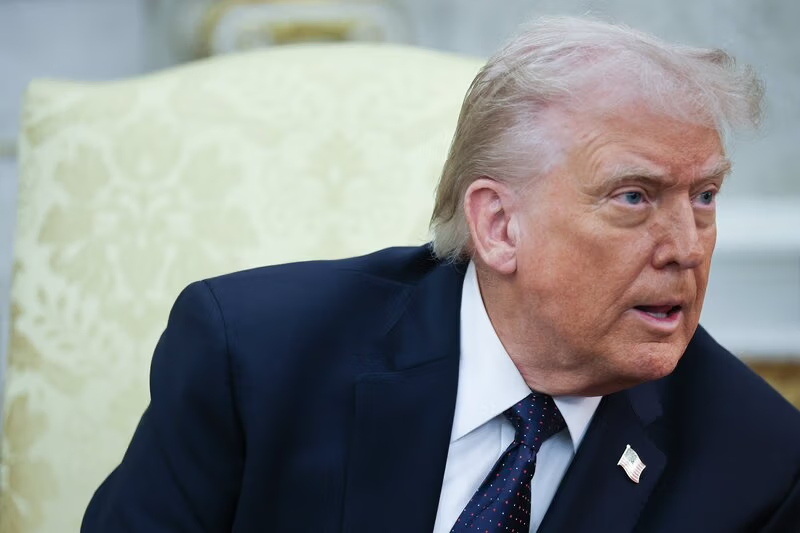
Trump’s Iran war strategy has come under intense scrutiny following a series of media interviews in which President Donald Trump defended the decision to launch military action against Iran, framing it as a preemptive strike designed to eliminate a direct threat, while critics question the legal basis, intelligence assessment, and long-term geopolitical consequences. In multiple appearances, Trump repeated his assertion that he acted before Iranian Supreme Leader Ali Khamenei could act against him, presenting the operation as both a national security imperative and a decisive demonstration of deterrence. The remarks followed joint US-Israeli strikes on Iranian military and strategic targets, an escalation that has reshaped regional dynamics and triggered diplomatic aftershocks across global capitals.
From a strategic standpoint, supporters of the Trump Iran war strategy argue that decisive military action reinforces deterrence doctrine by signaling that perceived threats will be met swiftly and forcefully, particularly in a region where proxy warfare and asymmetric tactics have long complicated traditional security frameworks. They contend that failure to respond would have emboldened adversaries and weakened US credibility among allies. The administration has maintained that the operation targeted specific military and security infrastructure rather than broader civilian assets, framing it as limited and focused in scope.
However, constitutional scholars and foreign policy analysts have raised questions about congressional authorization, the sufficiency of publicly presented intelligence, and the risk of escalation beyond initial objectives. Critics warn that removing senior leadership figures may create power vacuums or trigger retaliatory actions through regional proxies, increasing instability rather than containing it. Others highlight the economic dimension, noting that energy markets have already reacted sharply, with oil price volatility affecting inflation expectations and investor sentiment worldwide.
Domestically, the Trump-Iran war strategy intersects with political calculations as well. The president’s assertive posture plays to a segment of voters who favor strong executive action in foreign affairs, yet it also energizes opposition voices concerned about entanglement in another prolonged Middle East conflict. Lawmakers from both parties have called for classified briefings to clarify the intelligence underpinning the decision and to assess potential next steps.
International reaction has been mixed, with some allies emphasizing the need for de-escalation and diplomatic engagement even as they reiterate concerns about Iran’s regional activities. Multilateral institutions have urged restraint, aware that sustained conflict could disrupt global trade routes and energy supplies.
The coming weeks will determine whether the Trump Iran war strategy achieves its stated objective of strengthening deterrence or whether it ushers in a broader cycle of retaliation. For now, the debate reflects a deeper tension within US foreign policy between preemptive force and multilateral restraint, a balance that continues to define America’s role in an increasingly fragmented geopolitical landscape.