
U.S. President Donald Trump issued an executive order on Friday attempting to block the seizure of Venezuelan oil revenue in U.S. Treasury accounts.
Within the executive order, the revenue held in foreign government deposit funds is held solely for sovereign purposes, and any effort by a court to seize the funds will have a material adverse impact on the national security and foreign policy of the U.S.
The order, which proclaimed a national emergency, stated that funds are the sovereign property of Venezuela detained in U.S. custody for governmental and diplomatic purposes, and are not funds susceptible to private claims.
The order states that any judicial process against the funds will disrupt any efforts to “ensure economic and political stability in Venezuela.”
Trump signed the order almost a week after U.S. military forces detained the Venezuelan leader, Nicolás Maduro, and his wife, Cilia Flores, in Caracas. Both have been charged with drug trafficking, and both are found not guilty.
Although the military operations indicated that the two countries “are working well together” to restore the oil and gas infrastructure in Venezuela, and that the American oil giants will spend no less than $100 billion in the South American nation.
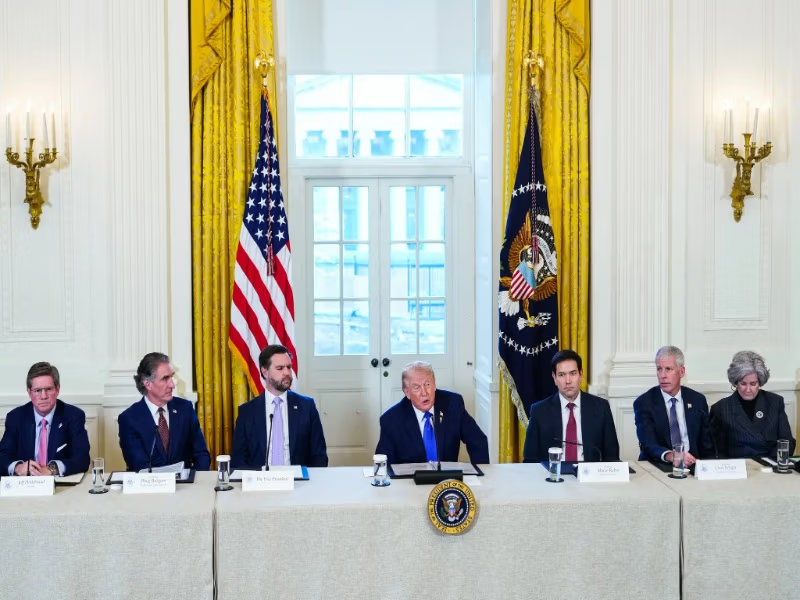
Trump later on Friday afternoon held a meeting with key oil industry players in an attempt to persuade the U.S. oil companies to invest in Venezuela. At that gathering, the ExxonMobil CEO, Darren Woods, informed Trump that Venezuela is “uninvestable.”
ConocoPhillips and ExxonMobil withdrew from Venezuela when its government, led by President Hugo Chávez, nationalized both the oil industry and several other major industries in the country.
Both firms have launched arbitration claims against Venezuela, demanding billions of dollars in compensation over assets that have been state-expropriated. Chevron is the sole large American oil firm that is presently functioning in Venezuela under a special license granted by the Trump administration.
Trump referred in his Friday order to the 1977 International Emergency Economic Powers Act and the 1976 National Emergencies Act as a legal basis to protect Venezuelan oil revenue in U.S. accounts. The White House did not immediately respond to a CNBC request for comment.