
U.S. President Donald Trump has unveiled a tariff framework for pharmaceutical imports that blends trade policy with pricing reform, using the threat of steep duties to push drugmakers toward lower prices and greater domestic production.
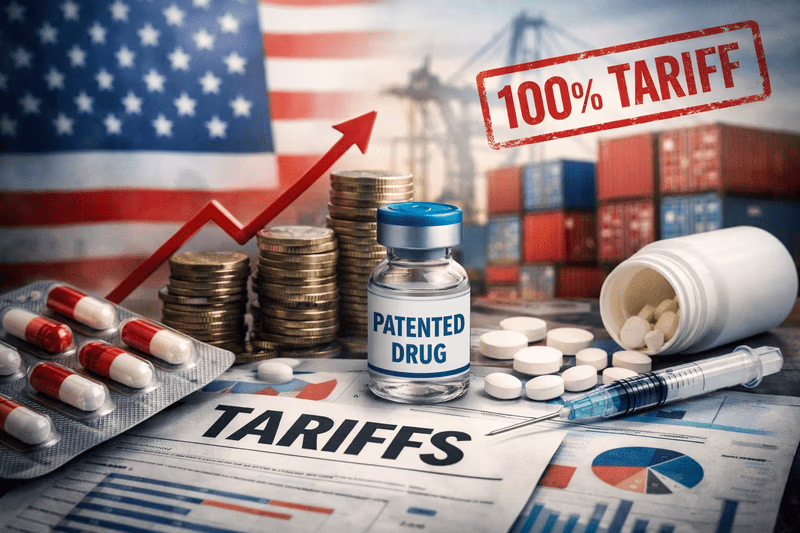
Under the plan, patented medicines entering the United States could face tariffs of up to 100 percent. In practice, however, the measure is structured as a conditional system, with companies able to significantly reduce or eliminate those tariffs by meeting specific policy objectives set by the administration.
Firms that commit to building manufacturing capacity in the United States before January 2029 would face reduced tariffs of around 20 percent. Those that go further, by agreeing to pricing arrangements with government healthcare programs, could see tariffs drop to zero, according to White House officials.
The approach effectively ties market access to two central demands: local production and lower drug prices. It reflects a broader shift in U.S. policy, in which tariffs are increasingly used not only to protect domestic industries but also to influence corporate behavior in strategically important sectors.
The immediate impact on consumers may be limited. The tariffs do not apply to generic medicines, which account for the vast majority of prescriptions in the U.S., reducing the risk of widespread supply disruption in the near term. However, the policy directly targets high-value patented drugs, where pricing has long been a point of contention.
For the administration, the pricing dimension is as significant as the manufacturing push. By linking tariff relief to pricing agreements, officials are seeking to bring U.S. drug costs closer to those seen in other developed markets, a longstanding policy objective.
Large pharmaceutical companies have already begun responding. Several firms have entered into agreements with the administration, while the industry as a whole has pledged substantial investment in U.S. manufacturing, estimated at around $400 billion. The tariff framework appears designed to accelerate that trend by increasing pressure on companies that have yet to commit.
The policy also incorporates a tiered global structure. Existing trade agreements with key partners, including Europe, the United Kingdom, Japan, South Korea, and Switzerland, will continue to offer lower or zero-tariff rates on certain pharmaceutical exports, thereby limiting disruption to established supply chains.
Smaller and mid-sized companies, however, may face greater challenges. With fewer resources to shift production or negotiate favorable terms, they are more exposed to the higher tariff bands, raising concerns about uneven impact across the sector.
There are also questions about cost dynamics. Manufacturing pharmaceuticals in the United States typically involves higher expenses than overseas production. While pricing agreements could offset some of those costs, their scope remains limited, leaving uncertainty about how the economics will ultimately balance.
Companies have been given a defined window to respond, with larger firms expected to reach agreements within 120 days and smaller companies within 180 days, underscoring the administration’s intent to move quickly from policy announcement to execution.
Taken together, the framework represents a hybrid strategy that combines protectionism with negotiation. Rather than imposing a uniform tariff, the administration is using conditional duties to reshape supply chains, influence pricing, and accelerate domestic investment.
The outcome will depend on how broadly companies choose to comply. If participation is widespread, the policy could mark a turning point in how the United States manages pharmaceutical costs and supply security. If not, it risks introducing new cost pressures into a system already under strain, with implications for both industry and patients.