
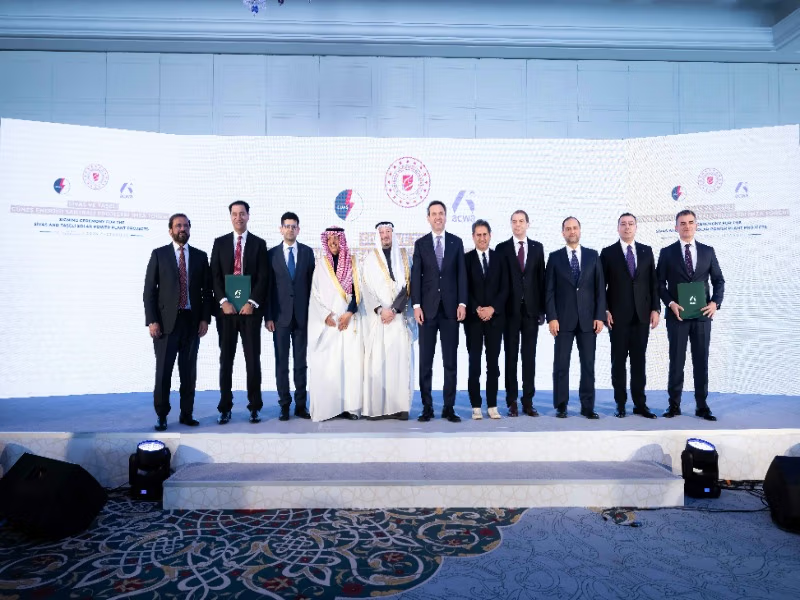
Saudi utility giant ACWA has also signed major investment deals with the Ministry of Energy and Natural Resources of Türkiye to build up to 5 gigawatts of renewable energy capacity, beginning with 2GW of solar power throughout two plants in Sivas and Taseli.
Press release reported that under the investment agreement, ACWA will build, finance, and construct, as well as commission and operate both facilities.
The statement stated that the program expands on the initial investment of the company in Türkiye, the 927 megawatts Kirikkale Independent Power Plant, worth of $930 million, that subsidies about 1.8 million tonnes of carbon dioxide annually.
An independent power purchase agreement has been finalized with Elektrik Üretim Anonim Şirketi to sell the electricity produced by each of the plants.
Türkiye is targeting a capacity of 120GW of solar and wind energy by 2035, with about $80 billion in investment, and recent developments have already achieved the prevention of 12.5 million tonnes of CO2 and decreased the need to rely on imported natural gas.
In recent years, the energy sector in Türkiye has experienced a swift transformation, with renewable power becoming a key element of its strategy.
Raad Al-Saady, Vice Chairman and Managing Director of ACWA, said, “The signing of the IA (implementation agreement) and PPA key terms marks a pivotal moment in ACWA’s partnership with Türkiye, reflecting the country’s strong potential as a clean energy leader and manufacturing powerhouse.”
He reported, “Building on our long-standing presence, including the 927MW Kirikkale Power Plant commissioned in 2017, this step elevates our partnership to a new level.”
ACWA, in its announcement, stated that a 5GW renewable energy plan will provide electricity at fixed prices, which will make the grid planning more predictable and will contribute to long-term industrial investment.
The effort to substitute imported fossil fuels with locally produced clean energy will lessen exposure to global energy market volatility, enhance energy security, and reduce long-term power costs in Türkiye.
The company further noted that the effects of this on the economy will go beyond the expected investment of up to $5 billion in foreign direct investment, and that thousands of jobs will be created during the construction process, and that hundreds of high-skilled jobs will be created during the operations.
The energy company decided that its current development in Türkiye is an appreciation of Turkish engineering, construction, and manufacturing capacity, and that it has made localization a strategic focus, and has already reached 100 percent local employment of its developments in the country.