

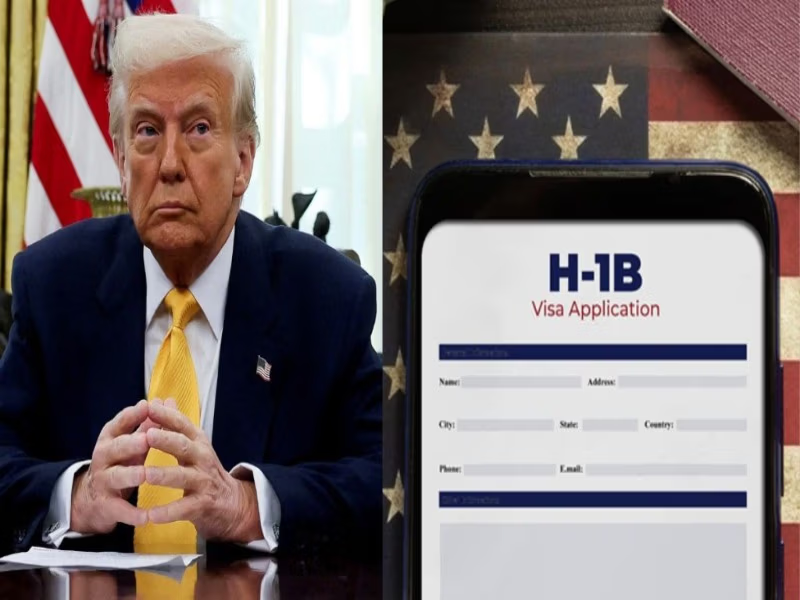
A U.S. appeals court on Monday agreed to expedite an appeal by U.S. business and research organizations against President Donald Trump’s fee of $100,000 on new H-1B visas to bring highly skilled foreign workers to the country.
The U.S. Chamber of Commerce, the largest business lobbying group, had argued that there was a need to be considered quickly so that the rights of the employers could be preserved before the H-1B visa lottery, which was formerly held once a year, could commence in March.
The Trump administration was not objecting to the faster schedule, and the court approved a plan whereby oral arguments will be conducted in February. The Chamber of Commerce and White House failed to respond immediately to demand comment.
As per the court documents filed by the Chamber, the annual process is the only available time to most employers in the United States who would like to hire skilled workers via the H-1B program to apply for the visas.
In court papers filed on Friday, the Chamber said, “Those employers’ ability to participate in the H-1B program this year therefore hinges on the outcome of this appeal; without relief by March, it will be too late.”
The Chamber had appealed on December 24 decision by a U.S. district judge, who concluded that the new fee fell within the president’s broad powers to regulate immigration.
Earlier, Trump imposed the new $100,000 fee in September; H-1B visas had come with about $2,000 to $5,000 in fees depending on different factors.
The H-1B program is a program that enables employers in the United States to hire foreign employees who are trained in specialty areas. Particularly, in technology companies, employees who are given H1-B visas are in high demand.
The program provides 65,000 visas each year, and an additional 20,000 worker visas with an advanced degree, which are granted for three to six years.
A new regulation released by the U.S. Department of Homeland Security has independently substituted the randomness of the lottery with a fresh allotment procedure that focuses on granting visas to those foreigners who are more skilled and higher-paid. The regulation will be implemented on February 27.
The Trump administration has indicated that the H1-B program has been misused by U.S. employers who would want to substitute American workers with foreign workers with low wages.
The Chamber claimed in the suit that the new charge would cause companies that depend on the H-1B scheme to either drastically raise their labor expenses or to employ fewer foreign and highly-skilled employees.
Therefore, the association of Democratic-controlled states in the U.S. and a set of employers, nonprofit, and religious agencies have also brought lawsuits alleging the fee.
The name of the case is Chamber of Commerce v. Department of Homeland Security, U.S. Court of Appeals for the District of Columbia Circuit, No. 25-5473. For the Chamber of Commerce: Paul Hughes of McDermott Will & Schulte, and Daryl Joseffer of the U.S. Chamber Litigation Center.
For the Association of American Universities: Lindsay Harrison of Jenner & Block. For DHS: Tiberius Davis, Glenn Girdharry, and Alexandra McTague of the U.S. Department of Justice.