
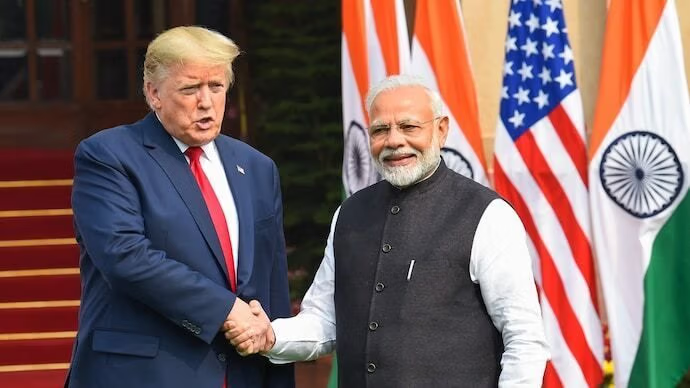
A new trade agreement between the United States and India, announced by U.S. President Donald Trump on February 2, 2026, will reduce U.S. tariffs on Indian goods and reflects shifting economic ties between the two nations. Trump said India would stop buying Russian oil and increase purchases from the United States, including petroleum products, as part of the U.S.-India Trade Deal. However, Indian officials have not publicly confirmed an immediate halt to Russian oil imports.
The agreement, announced after a telephone call between Trump and Indian Prime Minister Narendra Modi, will lower U.S. tariff rates on most Indian exports from 50 percent to 18 percent. The United States is also canceling a separate punitive 25 percent tariff imposed in 2025 on India’s continued purchases of Russian oil.
The U.S.-India Trade Deal marks a significant shift in trade relations and is expected to have long-term implications for economic cooperation.
According to Reuters and other reporting, Trump described the trade deal as part of a broader effort to strengthen economic ties and reduce trade imbalances, with India agreeing to “buy American” in sectors such as energy, defence, technology, and agriculture. The U.S. president said India could purchase up to $500 billion worth of U.S. products over time under the agreement.
On energy, Trump stated that India would discontinue purchases of Russian oil and increase purchases of U.S. crude and, potentially, Venezuelan oil. In public remarks, the U.S. president linked the shift in India’s oil sourcing to efforts to reduce Russia’s revenue amid the ongoing war in Ukraine.
Reuters reporting indicates that Indian refiners will need a transition period to complete existing contracts for Russian crude, as shipments booked through March 2026 are scheduled to arrive. At present, India has not publicly announced an official government directive to immediately stop imports of Russian oil, even as Russia’s share of India’s crude basket has declined.
The broader context includes a period of heightened tensions in trade relations between the United States and India in 2025, during which the U.S. administration imposed escalating tariffs on Indian exports, reaching up to 50 percent. Those measures were linked in part to India’s significant purchases of discounted Russian crude following the 2022 invasion of Ukraine.
Market reaction to the trade announcement has been notable. Indian financial markets responded positively, with the benchmark Nifty 50 index climbing and the rupee strengthening against the U.S. dollar following news of the tariff reduction and prospects for deeper bilateral trade.
While the U.S. and India have framed the agreement as a diplomatic breakthrough, details on implementation timelines, particularly regarding oil imports and the full scope of energy sourcing, remain unclear. Analysts expect follow-up discussions and formalised agreements to clarify specific commitments on trade flows, energy purchases, and tariff adjustments.