
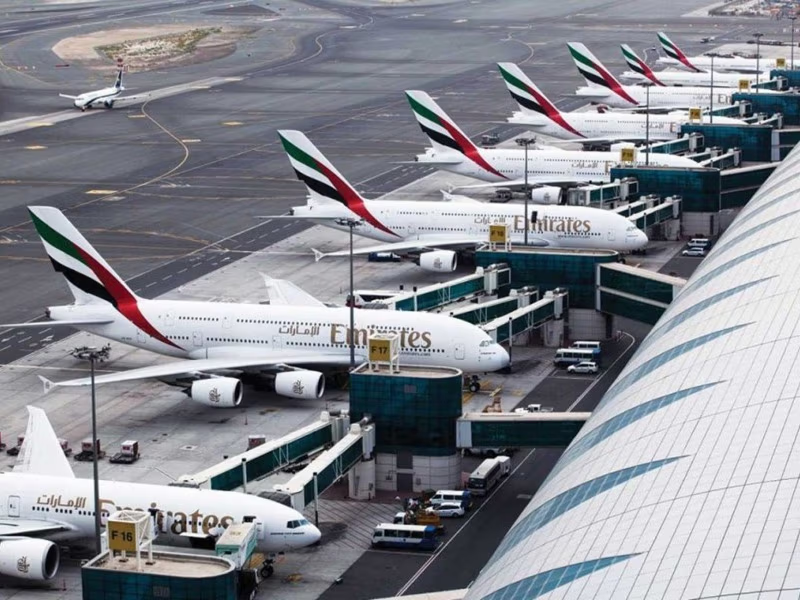
The UAE aviation industry remains in the process of consolidating its role as one of the strategic pillars of the national economy and as the world leader in terms of governance, innovation, and sustainability.
The industry experienced a list of qualitative performances in 2025, which strengthened its involvement in developing the competitiveness of the national economy and in helping to serve key areas, such as trade, tourism, logistics, and supply chains, and also made a direct and indirect contribution of up to 18 percent of the gross domestic product.
The General Civil Aviation Authority (GCAA) announced the unified national platform for unmanned aerial vehicles in January 2025 as an interactive digital platform to regulate and register the operation of unmanned aerial vehicles, clarify the requirements of their use and adherence to laws and regulations, and improve the level of safety and efficiency in the use of unmanned aerial vehicles and the investment environment.
The GCAA has awarded a Design Acceptance to the first hybrid Heliport in the country, the Abu Dhabi Cruise Terminal at Zayed Port, as part of the Abu Dhabi Air Taxi visionary project in April.
The hybrid Heliport will be a revolutionary move towards integrated and sustainable air transport within the emirate.
The GCAA remained at the forefront in the area of environmental sustainability by filing the third version of the State Action Plan to Reduce Aviation Emissions in the United Arab Emirates to the International Civil Aviation Organisation (ICAO), after its approval by the Cabinet.
The strategy was made in consultation with all stakeholders within the aviation industry in the country, aiming at facilitating the UAE in its global responsibility towards climate action, coupled with providing sustainable economic development in the aviation sector.
The most recent update indicates the proactive attitude of the UAE to international climate action and is a part of the national intentions of the country to present the national plans to reduce aviation emissions, as per ICAO Assembly Resolution A37-19 (2010) and follow-up resolutions of the Assembly.
The new plan uses an all-inclusive approach that incorporates a “basket of measures” that can cut down aviation emissions, comprising 42 projects in operations and technology, and 13 projects in sustainable aviation fuel and low-carbon fuels.
Another success that the UAE has registered on the international front is in electing a seat on the Council of the International Civil Aviation Organisation for the seventh consecutive term.
The organisation has also re-elected Hamad Salem Al Muhairi, the Assistant Director-General of the Aviation Security Affairs Sector of the General Civil Aviation Authority, as the Chairperson of the ICAO Aviation Security Panel for a third term of service.
Engineer Maryam AlBalooshi, a Senior Manager of the Environmental Affairs Office of the GCAA, has been chosen as the Chair of the Committee on Aviation Environmental Protection (CAEP) of the ICAO. Through this election, AlBalooshi becomes the first in the Middle East to be in this position.
The role contains a number of international activities connected with the future development of the aviation industry and the elimination of its negative influence on the environment, without excluding the necessity to keep the level of economic development and the further development of this important sector.
The UAE also emerged as a global centre of dialogue and defined the future of the aviation industry by hosting, organising, and attending various major international events such as the ICAO Global Implementation Support Symposium, as well as the inaugural edition of the UAE project, “Global Sustainable Aviation Market,” in Abu Dhabi.
The UAE Global Sustainable Aviation Marketplace (GSAM) has been officially accepted by the Council of the International Civil Aviation Organisation in its 235th Session as an institutionalised annual event with official ICAO calendar, which is not common to find an idea created by a state transform into a regular and internationally sponsored event.
Originally unveiled in Abu Dhabi in February 2025 during the ICAO Global Implementation Support Symposium (GISS), the GSAM initiative is designed to promote the realization of sustainable aviation fuels (SAF), low-carbon aviation fuels (LCAF), and climate finance solutions under the ICAO through the unification of ecosystem stakeholders, such as airlines, manufacturers, regulators, and investors (Finvest Hub).
UAE airports went on to record high levels of passenger numbers in the first nine months of 2025, as Abu Dhabi Airports, Dubai International Airport, and Sharjah International Airport recorded about 108.59 million passengers by the end of September.