

The UAE financial contingency mode was triggered over the weekend after missiles and drones crossed Emirati airspace, marking one of the most serious security shocks to hit the country’s commercial centers in recent memory. What had long been marketed as the Gulf’s most stable financial sanctuary is now undergoing its first real wartime stress test.
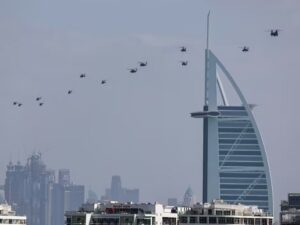
Air defense systems intercepted projectiles over Dubai and Abu Dhabi, with smoke reported near Palm Jumeirah, Jebel Ali port and parts of the capital’s diplomatic district. A suspected aerial strike partially damaged facilities at Dubai International Airport, while debris struck a facade at Etihad Towers in Abu Dhabi. Authorities moved quickly to contain damage and reassure residents, but the psychological impact on markets was immediate.
Wall Street Names Reassess Exposure
Several global institutions instructed staff to work remotely as part of precautionary measures. Among those reviewing operations were major banks such as Goldman Sachs Group Inc., JPMorgan Chase & Co., Citigroup Inc., Commerzbank AG and Nomura Holdings Inc..
Hedge funds with a growing presence in the Dubai International Financial Centre also reviewed business continuity frameworks. Millennium Management LLC and ExodusPoint Capital Management LP are among more than 100 firms now operating in DIFC. Meanwhile, Citadel LLC has previously signaled expansion ambitions in the emirate.
Singapore-based Dymon Asia Capital convened senior executives to draft wartime safety protocols for regional staff. Employees were advised to remain indoors, avoid glass facades and stay clear of embassies and military sites. Daily check ins were instituted to monitor personnel movements, and hotel accommodations were arranged for those stranded due to airspace closures.
Private Capital Firms Monitor Risks
The region’s appeal over the past four years has extended beyond hedge funds. Private equity and asset management giants, including Blackstone Inc., Brookfield Asset Management, and BlackRock Inc., have expanded their dealmaking teams across Abu Dhabi and Dubai.
KKR & Co., which invested roughly $2 billion in the region over the past year, advised staff to work from home while emphasizing a long-term investment approach. Executives stated they are engaging closely with portfolio companies to evaluate operational and safety requirements as developments evolve.
The UAE’s sovereign-backed expansion strategy, combined with tax incentives and regulatory clarity, had drawn global capital flows during the pandemic recovery and the post-Ukraine wealth migration. This latest escalation, however, punctures the so-called safety premium that differentiated Dubai from other regional hubs.
Aviation, Real Estate and Markets Feel Pressure
Airspace closures disrupted one of the world’s busiest transit corridors. Dubai International Airport and Abu Dhabi’s main terminals faced operational interruptions, while hotels were asked to extend stays for stranded passengers. Some private security firms reported evacuating high-net-worth individuals overland to Oman.
Market strategists are now examining potential second-order effects. Property prices in Dubai have climbed nearly 70 percent over four years following a powerful post pandemic rally. Elevated valuations could be vulnerable if geopolitical instability persists. Emerging markets analysts warn that sustained volatility may slow inbound capital and delay relocations that had been accelerating since 2022.
At the same time, roads across Dubai and Abu Dhabi were quieter than usual, with intermittent panic buying reported at supermarkets before authorities reassured residents about strategic reserves.
A Test of the UAE’s Financial Proposition
The broader question is whether the UAE financial contingency mode remains temporary or becomes a structural feature of doing business in the Gulf. The country built its modern financial identity on certainty within an unpredictable region. That proposition attracted hedge funds, sovereign wealth partnerships and multinational banks seeking geopolitical insulation.
Yet history shows the UAE has often converted crisis into opportunity. The rapid reopening during the Covid era and the absorption of capital fleeing other jurisdictions strengthened its role as a global connector. Some executives argue the same resilience will apply again, particularly if disruptions remain short lived.
For now, firms are balancing operational continuity with personnel safety. Remote work protocols, relocation planning and liquidity assessments are underway across trading desks and executive suites. While daily life continues in much of the Emirates, the weekend’s events serve as a reminder that even the most carefully constructed financial havens are not immune to regional shockwaves.
Whether this episode becomes a brief disruption or a lasting inflection point will depend on one factor above all others: duration. If tensions ease swiftly, Dubai and Abu Dhabi may reinforce their reputation for resilience. If not, the recalibration now underway inside boardrooms could reshape the trajectory of the Gulf’s financial ascent.