

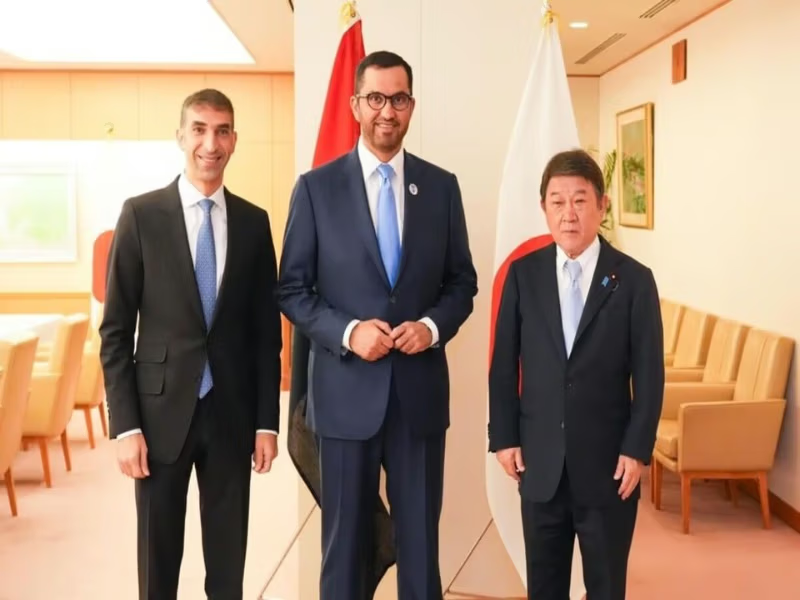
The UAE and Japan have ended negotiations on the final provisions of a Comprehensive Economic Partnership Agreement, signifying the first such accord Japan has signed with an Arab nation.
The Emirates News Agency shows that the deal will enhance trade and investment relationships, with the priorities being advanced technology, logistics, cybersecurity, healthcare, and education.
The UAE has established itself as a leading trading partner of Japan in the Middle East and Africa, with 39 percent of the overall Japanese trade with the Arab and African nations, with non-oil trade between the countries hitting $20.3 billion in 2025, an annual growth of 16.7 percent.
This announcement came after an official visit to Japan by Sultan bin Ahmed Al-Jaber, the UAE’s minister of industry and advanced technology and envoy of the Minister of Foreign Affairs, who was accompanied by Thani bin Ahmed Al-Zeyoudi, the minister of foreign trade.
The two officials also met with the Japanese foreign affairs minister, Toshimitsu Motegi, to sign the agreement, which stresses the concern of the two countries about strengthening the long-standing ties between the two countries.
Al-Jaber highlighted that the successful negotiations indicate the vision of the leadership to enhance the economic and trade ties with Japan, and the point that the strategic partnership between the two nations is profound.
It also emphasizes our mutual interest in facilitating innovation, industrial growth, and sustainable economic growth.
The CEPA has been a major milestone in bilateral relations, which is anticipated to improve trade and investment flows and boost cooperation among the private sector.
The agreement will also provide new areas of cooperation in science and technology, innovation, intelligent movement, energy security, financial services, and digital transformation.
These projects are consistent with the UAE’s vision of a knowledge-based economy and contribute to the priorities under the Comprehensive Strategic Partnership framework signed between the two nations in 2022.
Al-Jaber also said that the transaction would open new horizons of collaboration in the advanced industries and the resilient supply chains that would encourage increased investment and innovation in the private sectors of the two countries.
The resolution of the negotiations was also praised by Al-Zeyoudi, who pointed out the importance of collaboration with a large global economy.
He said, “The positive outcomes of our CEPA negotiations with Japan, one of the world’s largest economies and a key member of the G7, are a significant step forward in enhancing UAE-Japan relations.”
Al-Zeyoudi indicated that by removing trade barriers and facilitating surged investment flows, the CEPA “will unlock new avenues for our private sectors, fostering lasting partnerships that benefit both countries and contribute to our sustainability goals and shared prosperity.”
The agreement is a major element in the larger foreign trade strategy of the UAE. Since the inception of the CEPA program in September 2021, the UAE has signed similar agreements with over 35 high-growth economies, making the market more accessible to regions representing almost a quarter of the global population.