
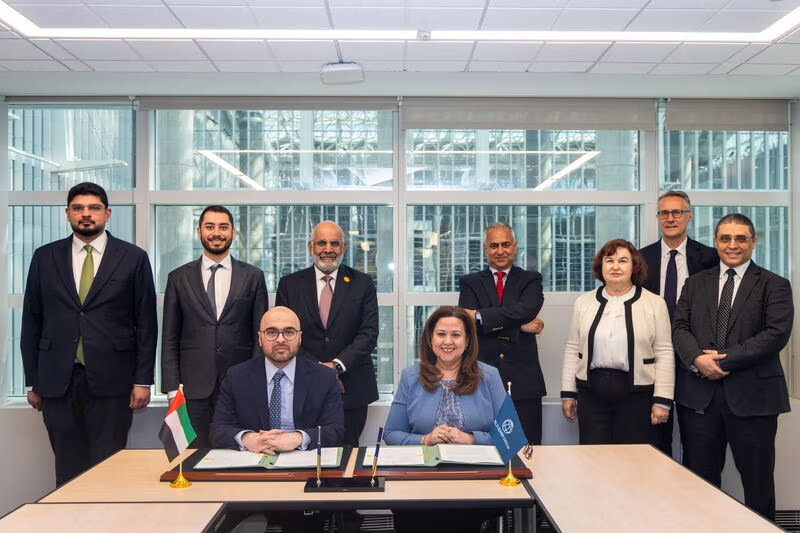
The UAE Ministry of Investment and the World Bank have signed a new partnership framework to strengthen the UAE’s investment climate and reinforce the country’s position as a leading destination for foreign direct investment.
The agreement focuses on enhancing transparency, predictability, and institutional competitiveness within the UAE’s investment ecosystem as the country seeks to expand its global investment footprint and accelerate economic diversification.
The framework was signed by Mohammad Abdulrahman Alhawi and Boutheina Guermazi.
The partnership falls under the broader cooperation agreement signed between the World Bank and the UAE Ministry of Finance in 2019.
Under the framework, the World Bank will support the UAE’s investment reform agenda through advisory expertise, institutional development support, and policy guidance to improve the country’s ability to attract and retain high-quality investment.
Mohammad Abdulrahman Alhawi said the partnership reflects the UAE’s ambition to strengthen its role as a strategic gateway for global capital.
“Entering the world’s top 10 FDI destinations in 2024 was a milestone, and our ambition is to double annual FDI by 2031 to reach US$65 billion,” he said.
The UAE has increasingly positioned foreign direct investment as a central pillar of its long-term economic strategy, particularly as the country expands beyond hydrocarbons into sectors such as technology, advanced manufacturing, renewable energy, logistics, healthcare, and financial services.
According to the Ministry of Investment, the framework will help deepen institutional capabilities required to compete in a rapidly evolving global investment landscape while supporting long-term policy stability.
Boutheina Guermazi said the collaboration aims to combine global expertise with locally tailored solutions to support sustainable economic growth.
The agreement also aligns with the UAE’s National Investment Strategy, which targets increased foreign capital inflows, stronger international partnerships, and continued integration into global trade and investment networks.
The UAE has continued attracting strong foreign investment inflows in recent years amid broader global economic uncertainty, supported by regulatory reforms, business-friendly policies, strategic geographic positioning, and large-scale infrastructure investments.
Industry analysts say institutional predictability and policy consistency are becoming increasingly important competitive advantages as countries compete globally for long-term investment capital.
The partnership further highlights the UAE’s broader strategy of leveraging international institutional collaboration to strengthen governance frameworks, improve market competitiveness, and sustain long-term economic resilience.
With input from WAM