
The US-Israeli attacks on Iran entered their fifth day as strikes continued across Tehran and other strategic areas, while Iran launched hundreds of missiles and drones in retaliation across the region. The conflict is rapidly expanding beyond direct military exchanges, affecting diplomatic compounds, energy infrastructure and several Gulf states.
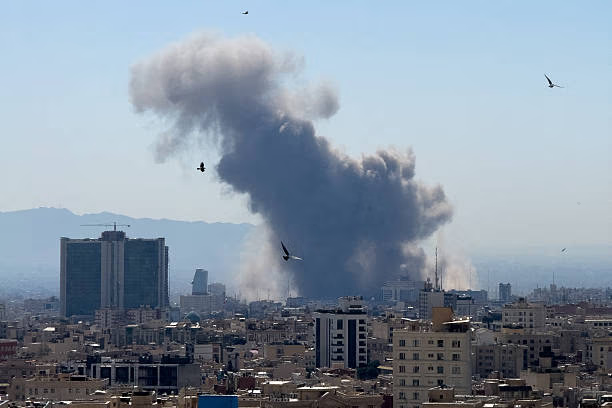
Plumes of smoke rise following reported explosions in Tehran on March 1, 2026, after Iran’s supreme leader, Ayatollah Ali Khamenei, was killed a day earlier in a large U.S. and Israeli attack, prompting a new wave of retaliatory missile strikes from Iran.
Military operations by the United States and Israel have targeted government, military, and nuclear-related sites, while Iran’s counterattacks have struck locations linked to US interests. The escalation has also triggered political debate in Washington and growing security concerns across the Middle East.
Strikes and explosions reported in Tehran
Joint operations linked to the US-Israeli attacks on Iran targeted western parts of Tehran, where video footage showed thick smoke rising above the city skyline. Officials say several government-linked and military locations were hit as part of the continuing operation.
One of the most significant developments was the strike on the Natanz nuclear facility, a key site in Iran’s nuclear programme. Iranian media confirmed the attack but reported that no radioactive leakage had been detected after the strike.
Israeli Prime Minister Benjamin Netanyahu said Israeli pilots are currently flying missions over Iran and the capital. He confirmed that Israel intends to continue the campaign, saying the country will strike Iran “with force.”
Iran launches massive retaliation
Iran responded to the US-Israeli attacks on Iran with a large wave of missiles and drones targeting US-linked facilities and regional infrastructure.
According to US Admiral Brad Cooper:
• Iran launched more than 500 ballistic missiles
• Around 2,000 drones were deployed in retaliation
• Several strikes targeted diplomatic or military sites across the Gulf
Some of these retaliatory attacks hit the US embassy in Saudi Arabia, while another drone strike occurred near the US consulate in Dubai in the United Arab Emirates.
A fire was reported near the consulate area as tensions in the Gulf continued to rise.
Rising casualties as conflict spreads
The human toll from the US-Israeli attacks on Iran is increasing rapidly. After four days of fighting, officials reported that nearly 800 people have been killed in Iran.
In neighbouring Lebanon, at least 50 people have died as Israeli forces continue bombardments targeting Hezbollah positions.
The Israeli military says it struck approximately 60 Hezbollah targets in southern Lebanon, including weapons depots, missile launchers and operational command centres.
Meanwhile, Hezbollah claimed responsibility for attacks against Israel:
• Rocket fire targeting Israeli forces in Metula
• A missile strike against a naval base in Haifa
These developments show how the US-Israeli attacks on Iran are now part of a broader multi-front regional confrontation.
Gulf region faces security threats
The ongoing US-Israeli attacks on Iran have created major security concerns across Gulf countries and shipping routes. Iran has warned it may target “all economic centres in the region” if the military campaign continues. Several security incidents have already been reported:
Qatar
Air defence systems intercepted projectiles over Doha, producing loud explosions in the sky. Authorities also announced the arrest of 10 suspected spies linked to Iran’s Revolutionary Guard Corps (IRGC).
Saudi Arabia
Two drones struck the US embassy in Riyadh, causing a small fire and limited structural damage.
Oman
Due to “ongoing activity,” the US embassy in Muscat instructed American citizens to shelter in place and remain in secure locations.
United Arab Emirates
A drone strike occurred near the US consulate in Dubai, while a vessel was hit by an unknown projectile seven nautical miles east of Fujairah, according to the UK Maritime Trade Operations (UKMTO).
These incidents illustrate how the US-Israeli attacks on Iran are affecting security far beyond the immediate battlefield.
Political tension grows in Washington
The US-Israeli attacks on Iran have also triggered intense political debate inside the United States.
President Donald Trump defended the military campaign, stating that “the big scale hitting goes now,” and warning that Iran is “in for a lot of hurt.”
Despite the aggressive military strategy, Trump said the objective is not necessarily regime change. Instead, he suggested that “someone from within” the Iranian government could potentially lead the country after the war.
However, many lawmakers are questioning the legal basis for the operation. The US Senate is expected to vote on the War Powers Act, which will test whether the president has the authority to continue the military campaign.
Following a lengthy briefing by Secretary of State Marco Rubio, several Democratic lawmakers warned that the United States could become involved in a long and costly ground war if the conflict escalates further.
Diplomatic tensions and rising death toll
International tensions surrounding the US-Israeli attacks on Iran have also reached European allies.
Trump criticised UK Prime Minister Sir Keir Starmer after Britain refused to support the military operation or allow attacks to be launched from the joint UK-US base at Diego Garcia. Trump remarked, “This is not Winston Churchill we’re dealing with.”
The human cost of the conflict continues to grow. The United States confirmed that four American soldiers were killed in an Iranian retaliatory strike on a military base in Kuwait, raising the total number of confirmed US military deaths to six.
As the US-Israeli attacks on Iran move beyond their fifth day, military operations, regional retaliation and global political tensions suggest the conflict may continue expanding across the Middle East.