

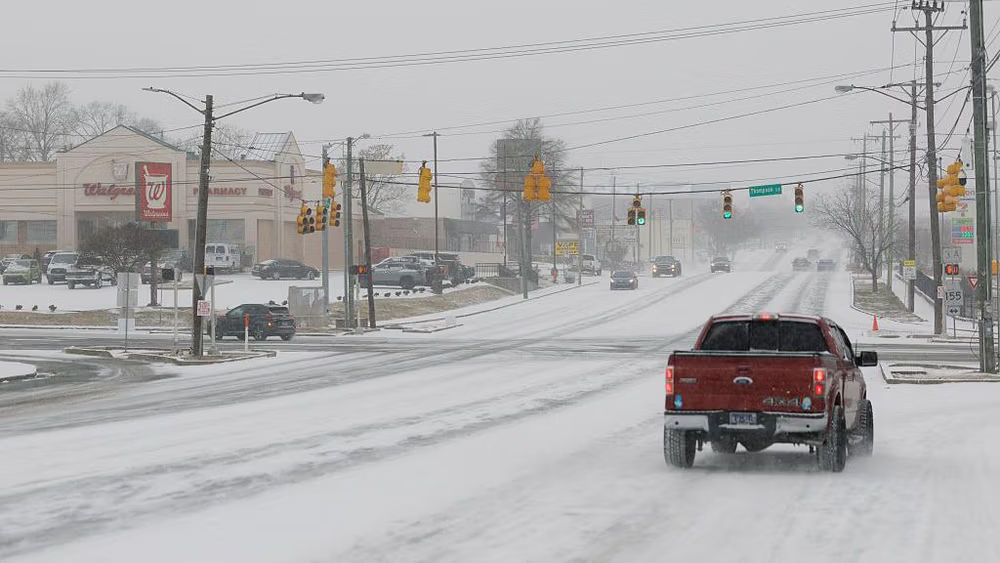
A powerful winter storm sweeping across the United States is fast becoming a major economic and infrastructure stress test.
Stretching from the southern Rocky Mountains to New England, the system is disrupting travel, straining power grids, and pushing energy prices sharply higher across some of the country’s most populated regions.
The scale of disruption is being compared to the chaos seen during last year’s US government shutdown, when staffing shortages crippled air travel nationwide. This time, weather is the trigger.
Travel grinds to a halt
Nearly 13,000 flights in and around the United States were canceled through Monday, according to FlightAware. Major airports across the Midwest, Northeast, and South have seen cascading delays as snow and ice intensify.
Public transport is also being curtailed. New Jersey Transit announced a full suspension of bus, light rail, and Access Link services for Sunday, January 25. Trains will operate only until 2 p.m.
“It’s a good weekend to stay indoors,” New Jersey Governor Mikie Sherrill said on Saturday. “Anything you need go out today and grab it and plan to stay off the roads tomorrow.”
Federal offices in the Washington DC area will be closed on Monday as conditions worsen.
Power systems under strain
The storm is pushing electricity demand sharply higher at the worst possible time.
About 132,000 homes and businesses were without power as of Saturday afternoon, according to PowerOutage.US. Roughly 60,000 of those outages were in Texas.
The Midcontinent Independent System Operator, which manages grids across parts of the Midwest and South, declared an Energy Emergency Alert 2 in its northern and central regions. The alert was triggered by forced power plant outages and limited transmission capacity.
An EEA2 indicates a power shortage and signals the need to reduce electricity demand to preserve reserves.
In the PJM Interconnection region, which spans from Chicago to Washington and hosts the highest concentration of US data centers, power prices surged. Electricity traded at $420 per megawatt hour Saturday afternoon after spiking above $3,000 earlier in the day. Prices were highest in Baltimore Gas and Electric territory at more than $550.
US Energy Secretary Chris Wright urged companies, including data centers, to activate backup power to relieve grid stress.
Energy prices spike across markets
Wholesale power prices in Texas jumped sharply overnight. Electricity reached $1,500 per megawatt hour in the Dallas Fort Worth area and $1,600 in the panhandle just before midnight. Those hours typically see low demand and low prices. By contrast, hourly prices peaked at about $44 on Saturday.
The storm is also disrupting fuel and industrial operations.
Exxon Mobil said it is shutting down some equipment at its Baytown refinery near Houston due to freezing conditions. The facility is one of the largest fuel-producing plants in the United States.
Celanese Corp. also scaled back operations at its Clear Lake chemical plant near Houston. The site produces materials used in paints, adhesives, and packaging.
Several US liquefied natural gas export facilities reduced gas intake on Friday. Sabine Pass in Louisiana, Corpus Christi LNG and Freeport LNG in Texas, and Cove Point in Maryland all showed lower activity, according to BloombergNEF data.
New England faces fuel constraints
New England is particularly vulnerable due to limited pipeline capacity.
As of Saturday afternoon, 31 percent of the region’s electricity was being generated by oil, according to the regional grid operator. That is higher than output from natural gas as generators switched fuels amid soaring gas prices.
Natural gas at the Algonquin Citygates trading hub surged to as high as $44 per million British thermal units this week. Utilities bid aggressively for scarce pipeline access as demand climbed.
Snow, ice, and economic damage
The storm is expected to drop up to half an inch of ice across the US South through northern Virginia. Heavy snow will spread from Oklahoma through the Ohio Valley and into New York and New England.
New York could see more than 14 inches of snow before the system moves out Monday, according to Scott Kaplan of Hometown Forecast Services. Boston may receive up to 20 inches. Washington could see 8 inches or more.
That would mark the heaviest snowfall in New York since January 2022 and in Boston since February 2022, according to the US Weather Prediction Center.
For the country as a whole, the system may rank among the most expansive winter storms since the 1993 superstorm, said Rob Carolan, chief executive of Hometown Forecast Services.
Economic losses could reach $24 billion, according to Chuck Watson of Enki Research. Swiss Re estimates that average annual insured losses from winter weather have more than tripled since 2021, reaching about $7 billion.
Most damage from winter storms comes not from snow alone, but from prolonged freezing temperatures that strain infrastructure and disrupt supply chains.
As the storm moves east, markets are watching closely. The impact is no longer just about weather. It is about resilience, energy security, and the rising cost of extreme events.