

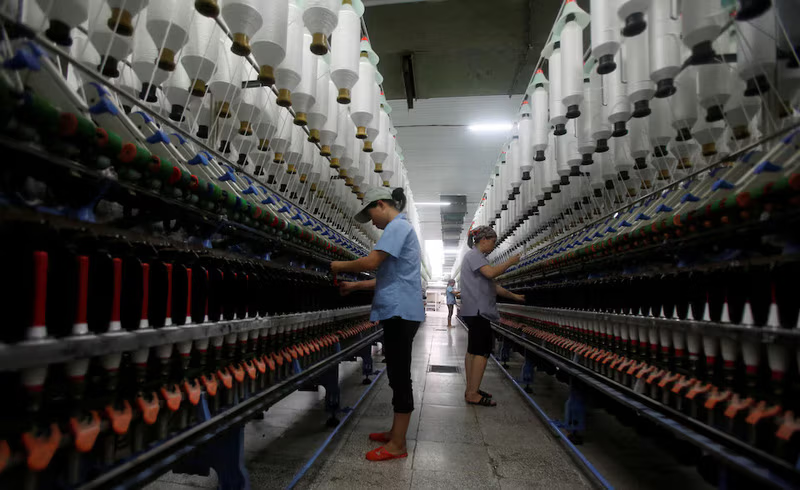
Vietnam’s economic story has long been defined by speed. Over the past decade, the country has emerged as one of Asia’s fastest-growing manufacturing hubs, powered by exports, foreign investment, and a steady integration into global supply chains. But the latest data suggests that even resilient economies are not immune to global shocks.
Growth slowed to around 7.8 percent in the first quarter, a modest pullback that reflects a deeper shift underway. The cause is not domestic weakness, but a surge in energy costs triggered by the ongoing Iran conflict, which has disrupted oil supply routes and pushed fuel prices sharply higher.
For Vietnam, the impact is immediate. The country relies heavily on imported energy, much of it sourced from the Middle East. As oil prices rise, the effect cascades through the economy, raising costs for transportation, manufacturing, and logistics. In an export-driven system, those pressures are difficult to contain.
The strain is already visible in inflation. Consumer prices have begun to edge higher, driven largely by fuel and transport costs. For businesses operating on tight margins, the increase is forcing difficult choices, whether to absorb the costs or pass them on, risking weaker demand.
What makes the situation more complex is that the underlying economy remains strong. Export growth continues at a healthy pace, and foreign investors have not pulled back. Vietnam’s position in global supply chains, particularly as companies diversify away from China, continues to support long-term confidence.
Yet the imbalance is growing. Imports are rising faster than exports, in part due to higher energy costs, pushing the country into a trade deficit. This dynamic underscores how external shocks can quickly alter even well-balanced growth models.
The government has moved to contain the pressure. Measures such as fuel tax adjustments and targeted support are being deployed to ease the burden on businesses and consumers. At the same time, authorities remain committed to ambitious growth targets, signaling confidence that the slowdown will be temporary.
Still, the episode highlights a structural vulnerability. Like many Southeast Asian economies, Vietnam’s growth model is deeply tied to global energy markets. When those markets are disrupted, the effects are felt quickly and broadly.
The situation also reflects a wider pattern across Asia. As geopolitical tensions reshape energy flows, economies that depend on imported fuel are facing rising costs and tightening margins, even as demand remains stable.
For Vietnam, the challenge now is to navigate this external shock without losing momentum. If energy markets stabilize, the current slowdown could prove short-lived. But if disruptions persist, the pressure on inflation, trade balances, and growth could intensify.
In that sense, Vietnam’s latest data is more than a quarterly update. It is a reminder that in an interconnected global economy, even the fastest-growing markets remain closely tied to forces far beyond their borders.