
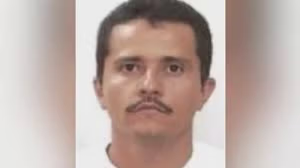
Nemesio Oseguera Cervantes, widely known as El Mencho, was killed during a Mexican military operation in the state of Jalisco, in what authorities describe as one of the most significant victories in the country’s fight against organized crime.
The powerful leader of the Jalisco New Generation Cartel was reportedly wounded in a firefight in Tapalpa and later died while being transported to Mexico City. US officials confirmed intelligence cooperation in the mission, underscoring the cross-border dimension of the operation.
The announcement that El Mencho was killed was quickly followed by widespread unrest.
Violent retaliation across multiple states
Within hours, suspected cartel members launched coordinated attacks across western and central Mexico. Authorities reported more than 250 road blockades spanning roughly 20 states. Highways were sealed using burning vehicles, public transport buses were torched, and businesses were set on fire.
Gun battles between armed groups and security forces were reported in several urban centers, including Guadalajara. Residents were advised to remain indoors as schools cancelled classes in affected regions. Airports operated under heightened security, with limited personnel present in some terminals.
Security officials confirmed casualties among both law enforcement officers and suspected gunmen, though comprehensive figures are still being assessed. During follow-up operations, military forces seized heavy weapons, armored vehicles and large quantities of ammunition.
The scale and coordination of the retaliation demonstrated the CJNG’s operational reach even after the loss of its leader.
Travel disruption and stranded tourists
The violence also disrupted international travel. The US State Department issued an advisory urging American citizens in certain parts of Mexico to shelter in place and avoid unnecessary movement.
Several US airlines suspended flights to Puerto Vallarta, leaving travelers stranded or seeking alternative routes. Passengers arriving at Guadalajara International Airport were informed that airport operations were functioning with reduced staff amid security concerns.
Local authorities worked to clear blockades and restore transportation corridors, but officials warned that instability could persist as security forces remained deployed across key regions.
Please see my statement on the security situation in Jalisco State, Mexico: pic.twitter.com/ptPbYyrhzw
— Anita Anand (@AnitaAnandMP) February 22, 2026
From rural poverty to cartel power
Born in 1966 in the state of Michoacán, Oseguera rose from modest beginnings to become one of the most wanted figures in global law enforcement. After migrating illegally to California in the 1980s, he was arrested on drug-related charges and later deported to Mexico.
Upon returning, he joined an established criminal network before consolidating power and forming what would become the Jalisco New Generation Cartel. Under his leadership, the organization expanded aggressively across western Mexico and built international trafficking routes stretching across North America, Europe and parts of Asia.
Authorities estimate the cartel generated billions of dollars in revenue, particularly through methamphetamine and synthetic opioid trafficking. His leadership was characterized by calculated violence, strategic territorial expansion and direct confrontation with state security forces.
Over the years, the United States increased the bounty for information leading to his arrest to 15 million dollars, one of the largest rewards ever offered in a narcotics case.
What happens next?
Security analysts caution that eliminating a cartel leader does not automatically guarantee stability. Previous operations targeting high-profile figures have sometimes resulted in internal power struggles and renewed violence as factions compete for control.
The long-term impact of El Mencho’s death will depend on whether the CJNG fractures internally or manages a rapid leadership transition. Authorities remain on alert for further retaliation.
While the operation represents a significant tactical success for Mexico’s government, the broader battle against organized crime remains complex. The killing of one of the world’s most wanted drug traffickers closes a major chapter in Mexico’s security landscape, but it does not necessarily mark the end of cartel influence.
For now, security forces continue patrols across affected regions as officials attempt to restore order following one of the most dramatic developments in the country’s ongoing drug war.