

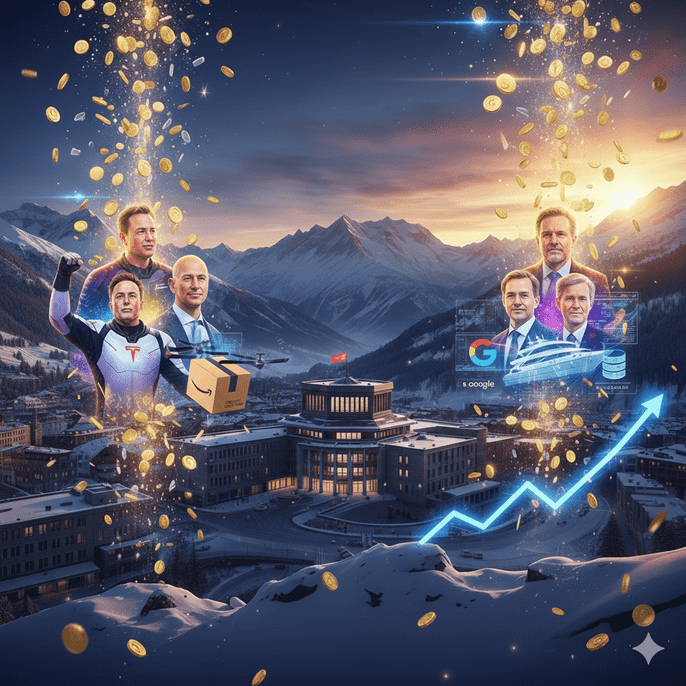
As global leaders gather in Davos, one number is dominating the conversation. Three thousand.
That is how many billionaires the world now has.
According to a new report by Oxfam, the number of billionaires worldwide crossed 3,000 for the first time in 2025. Their combined wealth climbed to a record $18.3 trillion. The report was released ahead of the World Economic Forum’s annual meeting, where inequality is expected to be a central theme.
A record year for billionaire wealth
Oxfam said billionaire fortunes rose 16 percent in 2025 alone, lifting total wealth to $18.3 trillion. That marks an increase of $8.2 trillion since 2020, or about 81 percent in five years.
The charity said the pace of wealth creation has accelerated sharply. Since November 2024, billionaire wealth has grown more than three times faster than the average annual rate seen since 2020.
The study draws on data from the World Inequality Database, academic research, and the Forbes rich list.
“The world’s 12 richest billionaires have more wealth than the poorest half of humanity, or more than four billion people,” Oxfam said.
Gains spread beyond the United States
While US billionaires recorded the fastest growth, Oxfam noted that wealth gains were not limited to America.
“Whilst US billionaires have seen the sharpest growth in their fortunes, billionaires in the rest of the world have also seen double digit increases,” the organisation said.
Rising equity markets, resilient corporate profits, and a surge in valuations linked to artificial intelligence have played a major role. Analysts have pointed to AI-related stocks and private technology firms as a key driver of new wealth creation over the past year.
Elon Musk breaks new wealth milestones
The report also highlighted the extraordinary gains made by Elon Musk in 2025.
“In October 2025, the world’s richest man, Elon Musk, became the first person to have wealth over half a trillion dollars,” Oxfam said.
Forbes reported that Musk later crossed $600 billion in December, making him the first person in history to reach that level. His net worth has since climbed further, touching $700 billion.
Much of that rise was linked to expectations around a potential SpaceX public listing at a valuation of about $800 billion. Musk owns an estimated 42 percent of the company. His wealth was also supported by his roughly 12 percent stake in Tesla, which posted a relatively strong second half of the year.
Who tops the global rich list
According to the Forbes Real Time Billionaires List, Elon Musk now sits far ahead of the rest.
He is followed by technology founders and investors who have benefited from long-running gains in US equities and the AI boom. Executives tied to semiconductors, cloud computing, and digital advertising feature prominently near the top.
Luxury goods and retail also remain major sources of wealth, reflecting resilient consumer demand at the high end of the market.
Here is a list of the top 10 richest people in the world, according to the Forbes Real Time Billionaires List.
1. Elon Musk, Tesla & SpaceX: Net worth – $779.6 billion
2. Larry Page, Google: Net worth – $270 billion
3. Jeff Bezos, Amazon: Net worth – $249.8 billion
4. Sergey Brin, Google: Net worth – $249.1 billion
5. Larry Ellison, Oracle: Net worth – $240.6 billion
6. Mark Zuckerberg, Facebook: Net worth – $212.8 billion
7. Bernard Arnault & family, LVMH: Net worth – $182.4 billion
8. Jensen Huang, NVIDIA (Semiconductors): Net worth – $161.7 billion
9. Warren Buffett, Berkshire Hathaway: Net worth – $146.1 billion
10. Amancio Ortega, Zara: Net worth – $143.1 billion
A growing political and economic fault line
Oxfam said the concentration of wealth has reached its highest level on record. The organisation has repeatedly called for higher taxes on the ultra-rich and stronger action to address inequality.
The report lands at a sensitive moment. Governments around the world are grappling with high debt, rising borrowing costs, and pressure to fund social spending. At the same time, asset owners have continued to benefit from market rallies and technological shifts.
As discussions begin in Davos, the contrast between record billionaire wealth and strained public finances is likely to shape debates on taxation, regulation, and the future of global growth.
For investors, the data highlights a deeper trend. Capital continues to flow toward scale, technology, and assets tied to long-term structural change. The question now is how long that dynamic can persist before political pressure reshapes the system.