

The United States’ dramatic military operation in Venezuela on January 3, 2026, which resulted in the capture of President Nicolás Maduro, has sent shockwaves through geopolitics, oil markets, and global strategic calculations.
While the initial focus has been on Latin America, the reverberations stretch across continents, notably to the Middle East and the United Arab Emirates (UAE), where energy, diplomacy, and economic stability are deeply intertwined with global oil markets.
A New Era of U.S. Interventionism
The mission in Caracas, involving U.S. Special Forces striking key military sites before detaining Maduro and flying him to New York, was framed in Washington as a law-enforcement action tied to longstanding criminal charges against the Venezuelan leader. Yet globally, the operation is widely seen as far more consequential. Analysts have compared it to the 1989 U.S. invasion of Panama in scale and controversy and raised alarms about precedent and international norms.
Instead of sparking panic in oil markets as geopolitical shocks once did, the initial price reaction was muted. Oil benchmarks such as Brent and West Texas Intermediate (WTI) slipped amid oversupply concerns, with Brent around $60-plus per barrel and WTI near $57 in early trade.
But the long-term implications for energy, especially for Middle Eastern producers and the UAE, go beyond immediate price volatility.
Why Venezuela Still Matters for Global Oil
Venezuela holds the largest proven oil reserves in the world, estimated at over 300 billion barrels, surpassing even Saudi Arabia.
This disparity matters. In 2026, the global oil market is shaped not just by reserves but by who can reliably produce and export crude at scale. For the Middle East and UAE, both of which rely heavily on oil revenues and stable export markets, this dynamic shapes strategic planning:
1. Venezuelan production remains structurally small. Years of mismanagement, sanctions, and underinvestment mean output is far below potential. Even if a new, U.S.-aligned government were to restore production, reviving Venezuelan oil would take years and massive investment, not months.
2. Oversupply, not shortage, defines 2026 markets. Global inventories are rising as OPEC+ unwinds production cuts and countries like the US and Brazil pump more crude. The International Energy Agency projects that supply could exceed demand by millions of barrels daily this year, keeping prices capped despite geopolitical risk.
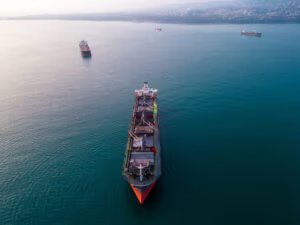
3. Heavy crude still plays a role. Venezuelan crude is predominantly heavy and sour, the kind used by complex refineries in the U.S. Gulf Coast and elsewhere. Middle Eastern producers, especially Iraq and Saudi Arabia, operate light and heavy grades, giving them flexibility. An eventual return of Venezuelan barrels would add supply diversity but is unlikely to displace established exporters in the near term.
For the UAE, which has aligned much of its economic strategy around responsible energy diversification, the situation is a reminder that oil geopolitics remain unpredictable even as renewables grow in importance.
Geopolitical Ripples in the Middle East
The US strike’s implications go beyond economics and oil supply. For Middle Eastern governments, the operation raises strategic and diplomatic questions:
1. U.S. interventionism signals a more assertive Washington. The Venezuela raid is being interpreted in some capitals as a shift toward a more unilateral foreign policy. Critics warn that actions perceived as violating sovereignty could undermine global norms.
2. Iran’s influence suffers a blow. Venezuela was one of Tehran’s closest allies outside its region, serving as a platform for logistical cooperation and mutual economic support. Iranian leaders condemned the strike as a violation of sovereignty. With Maduro gone, Tehran may lose this strategic foothold, which could diminish Iran’s ability to project power in the Americas and beyond.
3. Broader strategic rivalry evolves. China and Russia, both deeply invested in Venezuela’s oil sector and geopolitical alliances, have expressed concern about the US operation. There are risks of greater friction with Moscow and Beijing, which could shift diplomatic calculations across the Middle East, where both powers already have significant influence.
For the UAE and its Gulf neighbors, navigating these shifts will require balancing relations with the United States, maintaining strategic autonomy, and managing economic exposure to energy markets that remain sensitive to geopolitical developments.
What the UAE Should Watch Next
For the UAE specifically, the implications are layered:
Economic and oil market stability. Despite the limited immediate impact of the Venezuelan intervention on prices, energy markets could become more sensitive to geopolitical events. The UAE, as a key OPEC member and global energy exporter, will be monitoring any disruptions to supply chains, export routes, and refining balances.
Diplomacy and regional alignment. The UAE has cultivated relationships with major powers, including the US, China, and Russia, while positioning itself as a hub for global trade and finance. A more assertive U.S. stance could require delicate diplomatic engagement, especially if tensions escalate in other regions or if energy alliances shift.
Investment and energy strategy. Long-term investments in energy infrastructure, diversification into renewables, and financial markets position the UAE to weather volatility. However, the prospect of US companies potentially entering Venezuelan energy sectors — even slowly — highlights a future where Western energy capital could reshape parts of the global supply picture.
Conclusion: Oil Still Matters, But So Does Order
The U.S. military operation in Venezuela is a landmark moment, not just for Latin America but for global geopolitics and energy markets. For the Middle East and the UAE, the key takeaway is that oil remains economically vital, but political stability and strategic balance are equally crucial.
While the prospect of new Venezuelan supply offers a long-term subplot for global energy, the immediate priorities for the UAE and its regional partners are stability, predictable trade flows, and careful diplomacy in a world where geopolitical shocks can arrive with little warning.