
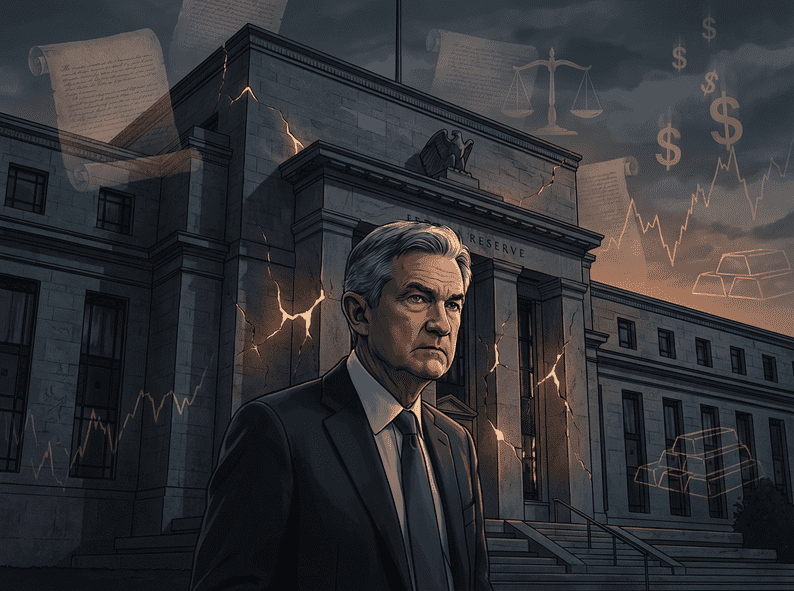
In an extraordinary escalation that has rattled global markets and raised fresh questions about the independence of the United States Federal Reserve, federal prosecutors have opened a criminal investigation into Federal Reserve Chair Jerome Powell. This development could have far-reaching implications for monetary policy, financial stability, and confidence in the world’s reserve currency.
Powell confirmed the investigation in a rare video message released on January 11, saying that the U.S. Department of Justice (DOJ) served the Federal Reserve with grand jury subpoenas, threatening potential criminal charges linked to his testimony before a Senate committee last year about renovations at the Fed’s Washington, D.C., headquarters.
A Historic Escalation in a Long-Running Feud
The inquiry centers on Powell’s June 2025 testimony about a multi-year, multi-billion-dollar renovation project at the Federal Reserve’s historic Marriner S. Eccles Building and adjacent facilities, and whether he misrepresented details to lawmakers. Prosecutors are reviewing spending records and his statements to Congress, though no charges have been filed and it remains unclear if a grand jury has been convened.
While the specifics involve construction oversight, Powell and many analysts say the move is better understood in the context of mounting political pressure from President Donald Trump, who has repeatedly criticized Powell for refusing to cut interest rates as aggressively as the White House desires. Trump, who originally nominated Powell to lead the Fed in 2017, has called for lower borrowing costs and even floated firing officials at the central bank.
“This unprecedented action should be seen in the broader context of the administration’s threats and ongoing pressure,” Powell said in his statement, adding that the investigation is a consequence of the Fed setting interest rates based on economic conditions rather than presidential preferences.
Why the Fed’s Independence Is So Critical
The Federal Reserve is designed to operate with institutional independence, insulating monetary policy decisions from day-to-day political influence. This independence is widely credited with helping the U.S. navigate economic crises, safeguard price stability, and uphold confidence in the U.S. dollar. Central bank leaders typically set interest rates based on inflation, employment data, and financial stability conditions — not political agendas.
Legal scholars note that presidents can only remove Federal Reserve officials “for cause,” a standard narrowly defined to prevent casual political interference. This legal protection underpins faith in the Fed’s ability to manage inflation and economic cycles.
Critics of the investigation warn that even the threat of criminal action against the Fed chair threatens to erode that shield of independence. Ian Bremmer, president of the Eurasia Group, said the probe suggests political loyalty — not rule of law — is driving prosecutorial actions, and industry observers fear broader repercussions for institutional credibility.
Market Reaction and Broader Economic Implications
Financial markets reacted swiftly. U.S. stock futures slid, the dollar weakened against major currencies, and gold surged toward record levels as investors sought safe havens amid uncertainty over U.S. monetary policy. Analysts at firms such as Goldman Sachs have warned that the investigation “reinforces concerns” that the Fed’s autonomy may be under threat, unnerving traders and long-term investors alike.
The implications extend beyond immediate market moves. Central banks around the world monitor Federal Reserve policy closely because U.S. interest rates influence global borrowing costs, capital flows, and exchange rates. If political considerations begin to shape monetary policy, it could have a cascading effect on everything from emerging-market debt to pension fund strategies.
Political Context and Trump Administration’s Role
President Trump has publicly rebuffed the idea that he was involved in the DOJ’s actions, telling NBC News that he did not “know anything about it,” even as he reiterated criticism of Powell’s performance both at the Fed and over building renovations.
Still, the probe fits into a broader pattern of legal and political pressure from this administration on figures perceived as resistant to its policy goals. Previously, Trump attempted to remove Fed Governor Lisa Cook, a move blocked by a federal court, and has continued to challenge Powell over rate decisions.
Why This Matters Beyond the Headlines
Economists and analysts caution that the investigation, even if ultimately unsuccessful, could alter how central banking is perceived in the United States and abroad. The belief that interest rate decisions are based on economic evidence rather than political will is foundational to investor trust. If that belief is shaken, markets may demand higher risk premiums, the dollar could face downward pressure, and inflation expectations could become unanchored.
As of early 2026, inflation forecasts and rate-cut expectations remain finely balanced, with tools like CME Group’s FedWatch showing fluctuating probabilities for future policy moves. The specter of political influence over rate decisions adds an unpredictable variable to that already complex calculation.
In the larger scheme, this unprecedented clash between the executive branch and the central bank underscores the fragile intersection of politics and economics — and highlights why the world watches the Federal Reserve so closely.