
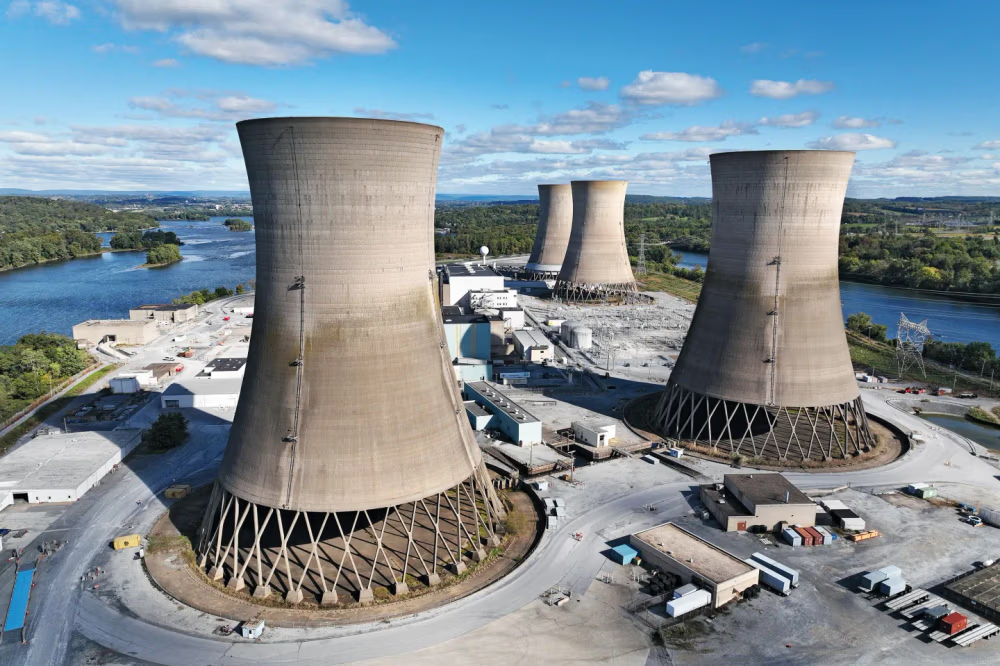
The United States is making a decisive and expensive bet on nuclear power again, and this time, the motivation goes far beyond energy.
On Monday, Washington announced plans to award $900 million each to Centrus Energy Corp., General Matter, and a subsidiary of France’s Orano SA, marking one of the largest federal investments ever aimed at rebuilding America’s domestic nuclear fuel supply chain. The goal is clear: reduce reliance on Russian-enriched uranium, secure fuel for next-generation reactors, and future-proof the power grid as electricity demand accelerates.
The market reaction was immediate. Centrus Energy shares jumped as much as 9.2% in New York, reflecting investor optimism that nuclear, long treated as politically sensitive and commercially risky, is back at the center of U.S. energy strategy.
Why Nuclear Fuel Has Become a National Security Issue
For decades, the U.S. quietly depended on imported enriched uranium, including supplies from Russia, even as relations with Moscow deteriorated. That vulnerability became impossible to ignore after Russia invaded Ukraine and the broader geopolitical realignment that followed.
Congress responded in 2024, passing legislation to ban Russian nuclear fuel imports, while allowing the US Energy Department to issue limited waivers through 2028 to avoid sudden supply shocks. The funding announced this week flows directly from that legislation and reflects a bipartisan recognition that nuclear fuel is no longer just an energy commodity… it is a strategic asset.
As the U.S. Energy Department noted in announcing the awards, the objective is to build a secure, domestic nuclear fuel supply chain capable of serving both existing reactors and the advanced designs now under development.
Who’s Getting the Money — and What They’ll Build
The largest share of attention is on Centrus Energy, the Maryland-based company that has emerged as a cornerstone of America’s nuclear revival. Its funding will support the development of next-generation reactor fuel, including high-assay low-enriched uranium, or HALEU, a specialized fuel required by advanced and small modular reactors.
Alongside Centrus, funding is going to General Matter, an advanced nuclear enrichment startup backed by Peter Thiel, and to a subsidiary of Orano SA, which plans to build a uranium enrichment facility in Tennessee. Together, these projects aim to rebuild capabilities that the U.S. once dominated but allowed to erode after the Cold War.
At present, the U.S. has only one major commercial enrichment facility, operated in New Mexico by Urenco Ltd., a European consortium. That leaves the country dangerously exposed in a world where energy supply chains are increasingly weaponized.
The AI Boom Is Driving the Nuclear Comeback
This nuclear push is also being fueled by a powerful economic force: electricity demand.
The rapid expansion of data centers supporting artificial intelligence has placed enormous strain on power grids, pushing electricity prices higher and drawing political scrutiny over rising utility bills. Nuclear energy — carbon-free, reliable, and capable of delivering constant baseload power — is once again being seen as a solution that renewables alone cannot provide.
As Energy Secretary Chris Wright put it in a statement announcing the awards: “Today’s awards show that this administration is committed to working hand-in-hand with industry and Congress to build a secure domestic nuclear fuel supply chain capable of producing the nuclear fuels needed to power the reactors of today and the advanced reactors of tomorrow.”
A Policy That Started Under Biden, Accelerated Under Trump
While the announcement comes under President Donald Trump’s administration, the policy itself began earlier. The funding was approved by Congress in 2024 as part of a broader initiative launched under former President Joe Biden to restart a long-dormant domestic enrichment industry.
What has changed is urgency. With geopolitical tensions rising, AI-driven power demand surging, and nuclear power enjoying renewed political backing, Washington is now moving faster and spending more to regain control over a critical segment of the energy supply chain.
This $2.7 billion commitment is not just about uranium. It signals a shift in how the U.S. thinks about energy independence, industrial policy, and national security in a more fragmented world.
If successful, the initiative could reshape global nuclear markets, weaken Russia’s leverage over reactor fuel, and anchor the next phase of America’s clean energy transition. If it falters, the U.S. risks remaining dependent on foreign suppliers at a time when energy has once again become a tool of power.
Either way, the nuclear era Washington once tried to leave behind is unmistakably returning — this time driven by geopolitics, AI, and a race to secure the fuels of the future.