

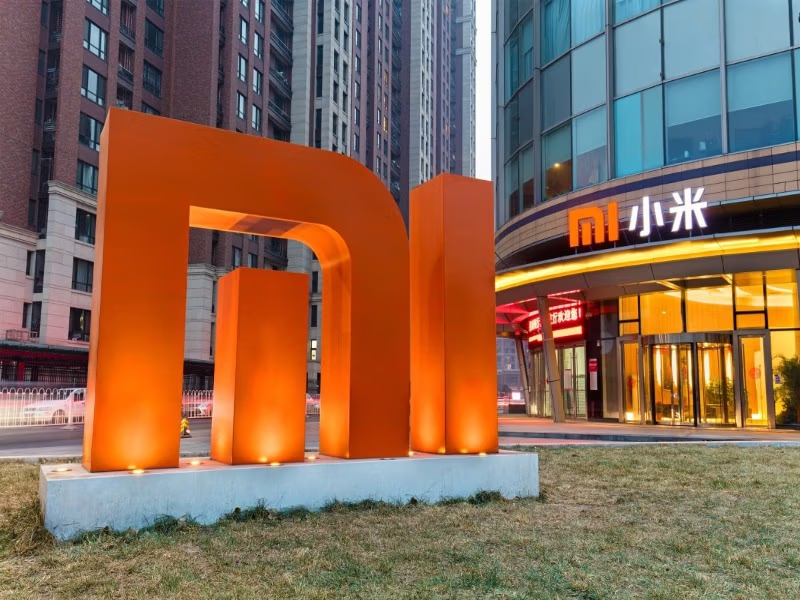
Chinese tech giant Xiaomi witnessed its shares surge over 2 percent on Friday following an announcement of a stock buyback plan valued at up to HK $2.5 billion ($321 million).
The buyback plan follows as the electric vehicle and smartphone maker to reassure investors amid intensifying competition, increasing component prices, and recent product safety concerns.
By Friday’s gain, shares of Xiaomi had plummeted over 8 percent this year, indicating sustained pressure on its valuation. In recent years, the company has regularly repurchased shares, including 4 million shares for HK$152 million on January 13.
Opponents of stock buybacks cite one of the reasons for such a practice being that it can elevate the share prices without enhancing the underlying business of a firm.
They claim that buybacks redirect funds to other investments, including their staff salaries, factory growth, employee creation, and innovation.
According to a filing with the Hong Kong Stock Exchange on late Thursday, the recent Xiaomi purchase will start on January 23 and will be done in the open market, subject to market conditions and regulatory approvals.
The Beijing-based company is also considered one of the largest consumer technology firms in China, specializing in smartphones, electric vehicles, and smart home equipment.
Analysts indicated that the stock has been under pressure recently as an imminent memory chip shortage threatens to push up component costs for its consumer devices, particularly smartphones.
Senior Equity Analyst at Morningstar, Dan Baker, said, ″[The shortage] has caused margin compression for smartphone manufacturers and a number of independent industry forecasters have lowered their outlook for smartphones.”
This memory shortage is projected to deteriorate this year, with manufacturers still prioritizing the increased memory needs of the AI sector, taking capacity away from electronics manufacturers.
Senior Analyst at Counterpoint Research, Ivan Lam, stated, “2026 is going to be challenging not just for Xiaomi but for many Chinese [Original Equipment Manufacturers] as domestic Android players remain most vulnerable to chip shortages.”
Xiaomi had also experienced pressure relating to its stocks last year after its vehicles were involved in accidents that went viral on social media. On a wider level, the company has felt the impact of the current price war in the Chinese EV market, which has strained the margins in the sector.
In terms of its EV business, Kyna Wong, a China technology analyst at Citi Research, added that investors were also disappointed when Xiaomi expected to deliver only a 550,000-unit vehicle delivery target for 2026.
She reported that margins on the company’s vehicle sales are expected to trend down due to changes to Beijing’s EV subsidy policies in 2026. Meanwhile, Xiaomi has been making massive investments in longer-term projects, such as an internal semiconductor division.
In the previous year, the company pledged at least 50 billion yuan over the next 10 years, beginning in 2025, to come up with its own chips. Xiaomi also intends to extend its business of electric vehicles to other parts of the world in the coming years after launching its premium SU7 ultra.