


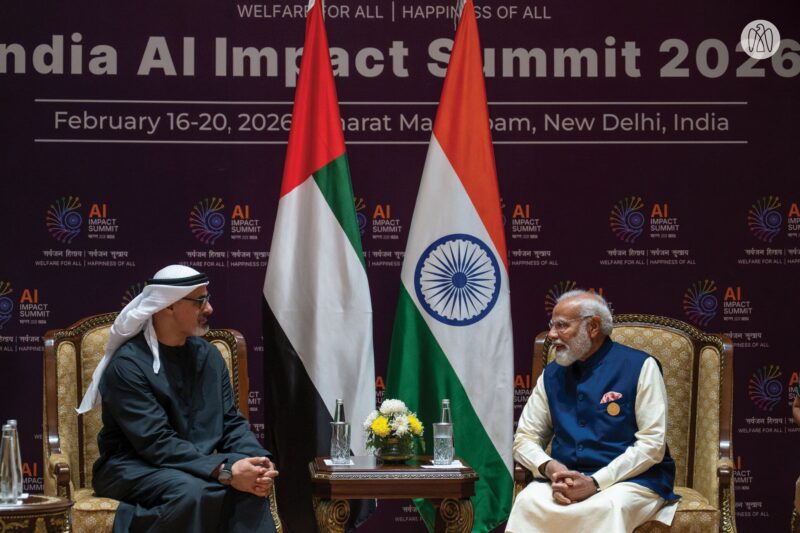
Image Courtesy: Media Office Abu Dhabi
The New Delhi Declaration on AI Impact has gained the backing of 86 countries, including the United Arab Emirates, as global leaders move to strengthen cooperation on artificial intelligence governance and inclusive growth. Adopted at the AI Impact Summit 2026 in India, The global AI framework seeks to reduce that gap reflects a growing international consensus that artificial intelligence must be developed and deployed in a way that benefits societies broadly rather than deepening global divides.
By supporting the New Delhi Declaration on AI Impact, the UAE reinforces its role as an active contributor to shaping international AI policy frameworks. The declaration was endorsed by major economies including the United States and China, along with two international organisations, highlighting rare multilateral alignment on the future direction of AI development.
A Framework for Shared AI Progress
The AI Impact declaration outlines a collaborative roadmap aimed at ensuring artificial intelligence supports economic expansion, technological innovation and social empowerment. Instead of introducing binding regulatory measures, the New Delhi Declaration on AI Impact promotes voluntary cooperation, multistakeholder engagement and respect for national sovereignty.
The declaration emphasises that accessible AI tools, open innovation ecosystems and cross-border knowledge exchange are essential for scaling solutions across both advanced and developing economies. It positions AI not merely as a commercial driver, but as a mechanism for expanding access to knowledge, services and opportunity.
Addressing Uneven Global Adoption
One of the core motivations behind the New Delhi Declaration on AI Impact is the uneven distribution of AI capabilities worldwide. Advanced economies face higher levels of AI-related workplace transformation, while emerging and lower-income nations often struggle with limited access to computing infrastructure, advanced semiconductors and data resources.
Without coordinated international cooperation, these structural imbalances risk widening disparities in productivity and competitiveness. The New Delhi Declaration on AI Impact seeks to reduce that gap by encouraging knowledge sharing and inclusive governance mechanisms that allow broader participation in AI-driven growth.
The declaration is built around seven pillars, including democratising AI resources, fostering economic growth and social good, strengthening secure and trusted AI systems, promoting AI for science, expanding access for social empowerment, investing in human capital development and building resilient innovation ecosystems.
UAE’s Expanding AI Strategy
For the UAE, endorsing the New Delhi Declaration on AI Impact aligns with its long-term economic diversification strategy. Artificial intelligence has become a central pillar in the country’s transformation into a knowledge-based economy. By backing the global AI cooperation agreement, the UAE signals its intent to combine rapid technological advancement with responsible governance.
The UAE delegation to the summit was led by Sheikh Khaled bin Mohamed bin Zayed Al Nahyan on behalf of President Sheikh Mohamed bin Zayed Al Nahyan. The country’s participation reflects its ambition to remain at the forefront of global AI dialogue.
During the summit, Abu Dhabi-based AI group G42 signed a partnership with US governance platform Credo AI. The collaboration focuses on advancing responsible AI adoption, including the development of risk-monitoring tools, policy design frameworks and educational initiatives aimed at strengthening ethical AI deployment.
Infrastructure and Global Partnerships
The UAE’s AI ecosystem has expanded significantly through strategic partnerships with global technology leaders such as Microsoft, Nvidia and OpenAI. These collaborations have enhanced domestic research capacity and accelerated AI deployment across sectors including healthcare, finance and logistics.
The country is also working with the United States to develop a major AI campus in Abu Dhabi, expected to include up to five gigawatts of advanced data centre capacity. This infrastructure investment positions the UAE as a regional computing hub capable of supporting large-scale AI innovation.
Looking ahead, the UAE will host the global AI Summit in 2028, further cementing its role in shaping international AI governance discussions.
As artificial intelligence continues to reshape global industries, the New Delhi Declaration on AI Impact represents a coordinated effort to ensure that innovation drives inclusive and sustainable growth. By joining 86 nations in supporting the AI impact framework, the UAE positions itself not only as an adopter of advanced technologies, but as a contributor to defining the global standards that will guide AI’s future.