
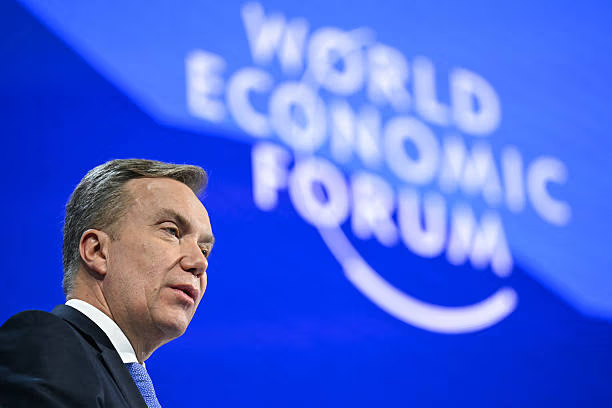
Borge Brende has resigned as president and chief executive of the World Economic Forum following renewed scrutiny linked to documents released by the United States Department of Justice concerning Jeffrey Epstein. His departure ends more than eight years at the helm of one of the most prominent global policy institutions.
Borge Brende confirmed that he met Epstein several times between 2018 and 2019 and communicated with him during that period. He stated that he was unaware of Epstein’s prior criminal record at the time of those interactions. In response to public attention surrounding the document release, the World Economic Forum commissioned an independent review. According to the organisation, the review did not identify additional concerns beyond previously disclosed interactions. Despite that conclusion, Borge Brende said stepping aside would allow the forum to continue its work without distraction.
Resignation Following Independent Review
The resignation came after weeks of scrutiny triggered by the release of a large collection of investigative materials by US authorities. The disclosures prompted renewed examination of individuals who had interacted with Epstein in professional or social settings. Being referenced in such documents does not imply wrongdoing, and Borge Brende has not been accused of criminal conduct. Nevertheless, the situation generated public discussion across political and business communities.
In his statement, Borge Brende said that after careful consideration he believed it was the appropriate moment to leave his role. The co chairs of the World Economic Forum thanked him for his contributions and confirmed that an interim president and chief executive would assume responsibilities while the board of trustees begins the search for a permanent successor.
The episode reflects the broader environment of heightened scrutiny facing global institutions. Leaders of international organisations are increasingly expected to demonstrate transparency and proactive governance in response to reputational concerns.
From Norwegian Cabinet to Global Leadership
Before joining the World Economic Forum, Borge Brende had an extensive career in Norwegian public life. Born on September 25, 1965, he became a senior member of Norway’s Conservative Party and held several cabinet positions.
His ministerial roles included:
- Minister of the Environment from 2001 to 2004
- Minister of Trade and Industry from 2004 to 2005
- Minister of Foreign Affairs from 2013 to 2017
As foreign minister, Borge Brende represented Norway in major diplomatic discussions and multilateral forums. His experience in international affairs strengthened his reputation as a consensus builder and policy negotiator.
In 2017, Borge Brende transitioned to global leadership when he was appointed president and CEO of the World Economic Forum. The organisation is best known for its annual meeting in Davos, Switzerland, where political leaders, business executives and experts gather to discuss global economic and social challenges.
During his tenure, Borge Brende oversaw initiatives focused on sustainability, climate dialogue, digital transformation and cooperation between governments and the private sector. Under his leadership, the forum continued to position itself as a platform for cross border engagement on pressing global issues.
The recent document release by US authorities reignited international scrutiny of individuals who had previous contact with Epstein. In Norway, several prominent figures have also faced public attention following the disclosures. The broader discussion has centred on accountability and transparency among leaders connected to global networks.
Borge Brende acknowledged that he regretted not examining Epstein’s background more thoroughly at the time of their meetings. The independent review initiated by the World Economic Forum aimed to clarify whether any undisclosed concerns existed. The organisation stated that the findings did not reveal additional issues.
His resignation underscores how reputational considerations can influence leadership decisions in international organisations. Even in the absence of allegations of misconduct, associations can carry consequences in a highly interconnected public sphere.
For the World Economic Forum, the leadership transition comes at a significant moment. The annual Davos meeting remains a symbol of global cooperation, and maintaining institutional credibility will be central to its future direction.
For Borge Brende, the decision closes a chapter that bridged Norwegian national politics and global policy leadership. His career has spanned cabinet service and stewardship of a major international forum. As the organisation prepares to appoint a permanent successor, attention will focus on how it navigates this period of transition and reinforces trust in its governance framework.