U.S. crude oil prices increased by over 8 percent on Sunday evening, as market participants are increasingly anxious that war between the U.S. and Iran will get out of control and cause a significant supply outage.
U.S. crude oil rose more than 8 percent, or $5.55, to $72.57 per barrel by 6:41 p.m. ET. Global benchmark Brent surged about 9 percent, or $6.54, to $79.41.
The enormous wave of airstrikes by the U.S. and Israel on Iran has killed Supreme Leader Ayatollah Ali Khamenei and other senior leaders in the Islamic Republic.
It remains uncertain who will eventually control the fourth-largest oil exporter in OPEC. The final response of the oil market will be determined by the probability of the war causing an extended disruption of traffic in the Strait of Hormuz, which is the most significant choke point in the global oil trade.
UBS analysts led by Henri Patricot told clients in a Sunday note, “We view the pace of the rebound in traffic through Hormuz and the extent of Iranian retaliation as key for the oil price in the next few days.”
President Donald Trump announced on Sunday that combat operations will be ongoing until all U.S. objectives are achieved. Trump previously stated that Iran is willing to negotiate, and he has agreed to it, which leaves open the possibility of de-escalation without resulting in a massive and sustained disruption.
“They want to talk, and I have agreed to talk, so I will be talking to them,” Trump told The Atlantic on Sunday. The president told CNBC that U.S. military operations in Iran are “ahead of schedule.”
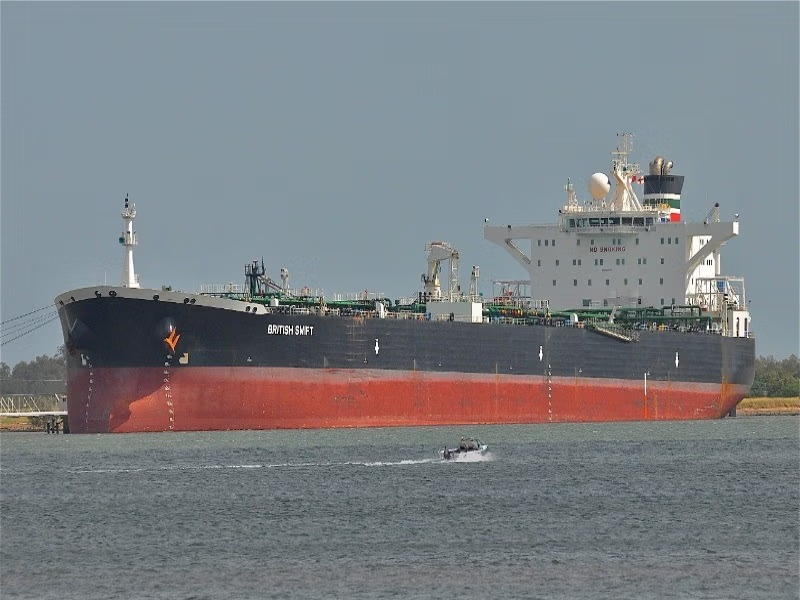
Consulting firm Rystad Energy said that in effect, tanker traffic across the Strait has already been halted as shipping companies assume precautionary actions.
Matt Smith, oil analyst at energy consulting firm Kpler, stated, “Tankers are starting to build by the Strait of Hormuz, but nothing seems to be going through at the moment – tankers are definitely spooked.”
Kpler data reported that more than 14 million barrels per day were supplied through the Strait on average in 2025, or about a third of the world’s total seaborne crude exports. The firm says that approximately three-quarters of its exports are sold to China, India, Japan, and South Korea.
Barclays analyst informed clients in a Saturday note that Brent might even reach $100 barrels per barrel as the security situation in the Middle East deteriorates. The market may be considering a material disruption that will push Brent spot prices over $120 per barrel, the UBS analyst told their clients.
Barclays analyst Amarpreet Singh told the client, “How this ends is extremely uncertain at this point, but in the meantime, oil markets will have to face their worst fears. The potential effect on oil markets is hard to overstate.”
Andy Lipow, president of Lipow Oil Associates, added that Iranian oil exports might also fall due to uncertainty over which faction is in power in Tehran, internal conflicts, and union strikes in its oil-producing fields and ports. Iran is capable of producing 3.3 million bpd.