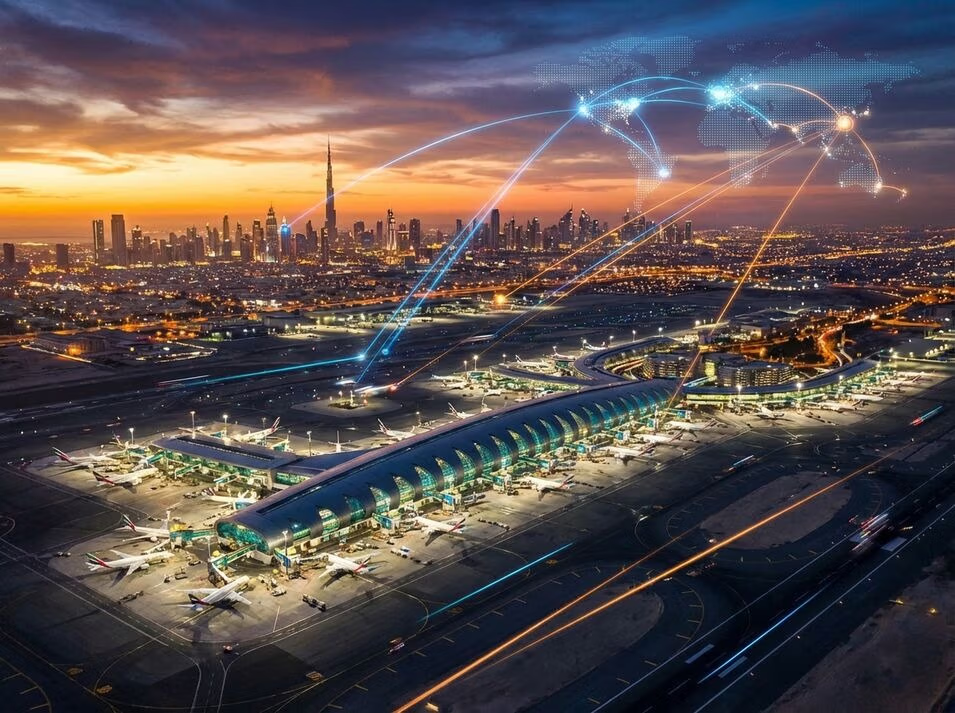
Global aviation has been reminded of a hard truth. Much of international air travel depends on a few Gulf mega hubs. At the center is Dubai International Airport, the world’s busiest airport for international passengers.
Escalating conflict in the Middle East has forced the shutdown of Gulf airspace. The ripple effects were immediate. Airline networks from Europe to Asia were thrown into disarray.
Dubai’s rise has been decades in the making. In 1985, Emirates launched with just two leased aircraft and two routes. Today, Dubai sits at the heart of a network spanning 110 nations and roughly 454,000 flights a year.
“That we’ve got such a well-spread geographic business model and are well spread between visitors and those in transit suggests it’s very robust and will continue to survive any geopolitical tension that exists, wherever it may be,” Dubai Airports CEO Paul Griffiths told Reuters in a recent interview.
On Saturday, U.S. and Israeli strikes against Iran brought the crisis closer. Dubai was directly affected, including an attack on the airport itself.
Network Under Pressure
Dubai now faces the task of managing tens of thousands of displaced passengers. It must also rebuild complex flight schedules while protecting Dubai-bound traffic, which accounts for about half of total passenger numbers.
The shutdown of Dubai, Abu Dhabi and Doha at the same time is unprecedented. Analysts say recovery is likely if the conflict is short lived. The Gulf hubs have scale and strong network effects.
“There’s no doubt at all this is temporary. They have seen major incidents before and recovered very quickly due to their importance as global hubs,” said UK travel consultant Paul Charles. “They will recover quickly, even if there is substantial uncertainty in the short term.”
Others are more cautious. During the COVID-19 pandemic, demand eventually surged beyond supply. This time, demand itself could weaken.
“Travellers are likely to consider more direct flights rather than stop over in Dubai or Doha. All this hub traffic is likely to take a hit,” said aviation adviser Bertrand Grabowski.
Geography Still Favors the Gulf
Dubai’s location remains a structural advantage. Griffiths noted that one third of the world’s population is within four hours’ flying time and two thirds within eight hours.
“We’ve seen the incredible aggregation power that a hub delivers,” he said.
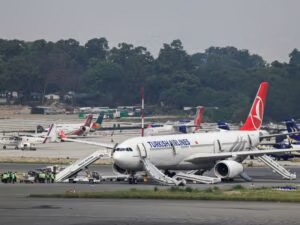
But competition is rising. Turkish Airlines could benefit in the short term through its Istanbul hub outside the conflict zone. Saudi Arabia is expanding aggressively. India is investing heavily in airport infrastructure and long haul capacity.
Aircraft technology is also reshaping the market. Airbus recently began assembling another ultra long range A350 for Project Sunrise. The jet will allow Qantas to operate nonstop flights from Sydney to London. More direct routes reduce reliance on traditional transit hubs.
A History of Growth in Crisis
Emirates was founded during the Iran-Iraq war. Its rapid expansion later led to the breakup of Gulf Air’s shared model, as Qatar and Abu Dhabi created their own carriers. A powerful trio of Gulf hubs emerged.
Now that dominance faces a fresh test. Iranian attacks and falling missile debris have shaken Dubai’s reputation for stability. Analysts say the biggest uncertainty surrounds traffic to Dubai as a destination.
Expansion plans for a vast new airport outside the city were already delayed. The latest crisis raises new questions about timing and investment.
Dubai destination traffic “will doubtless recover, but there is likely to be some lasting damage”, Grabowski said.
For Emirates and sister carrier flydubai, restoring momentum may involve pricing power.
“People have short memories and they might be incentivised by some bargain deals to bring people back, but I don’t think that would need to be there for long,” said Eddy Pieniazek of aviation consultancy Ishka.
For investors and airline executives, the message is clear. Dubai’s hub model remains powerful. But in a more volatile Middle East, even the world’s busiest international airport is not immune to geopolitical risk.