
The Project Hail Mary movie is taking an unusual approach for a large-scale science fiction production, with filmmakers opting to avoid extensive green-screen work in favor of practical sets despite the film’s sizable budget.
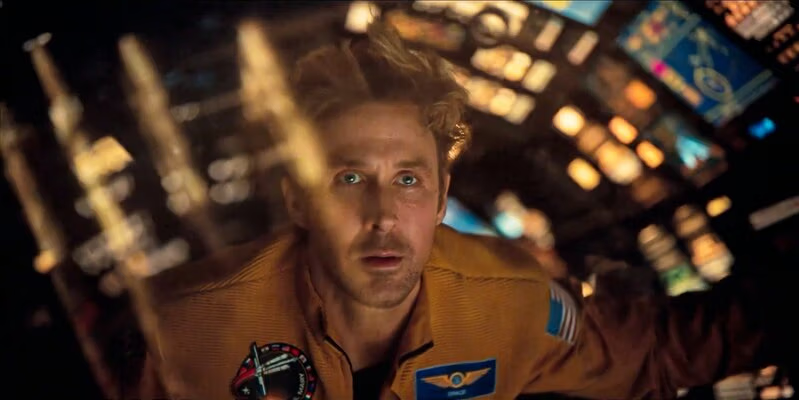
The upcoming adaptation of Andy Weir’s bestselling novel is being directed by Phil Lord and Christopher Miller and stars Ryan Gosling in the lead role as a scientist tasked with saving humanity from a cosmic threat. Instead of relying heavily on digital environments, the production team built large physical sets to recreate the spacecraft and space station environments featured in the story, a decision intended to enhance realism and performance.
The film, based on the novel by Andy Weir, follows a middle school science teacher who wakes up alone aboard a spacecraft with no memory of his mission but gradually discovers he must solve a complex scientific mystery to prevent Earth’s extinction. Producers say the story’s heavy focus on science and problem-solving encouraged them to prioritize immersive environments that actors could physically interact with rather than acting against digital backgrounds.
According to production reports, the filmmakers constructed detailed spaceship interiors and mechanical environments in studio facilities to replicate the claustrophobic, technical setting described in the novel. The goal was to create a more grounded visual style that captures the isolation of deep space while giving performers tangible surroundings to work within. In recent years, major science fiction films have increasingly relied on computer-generated imagery and green-screen stages to simulate outer space, but Project Hail Mary is attempting to balance visual effects with traditional filmmaking techniques.
Industry observers say this approach reflects a broader shift in Hollywood toward practical effects and physical set design, particularly after audiences responded positively to films that combine digital technology with real-world production elements. Large practical builds can require significant investment and logistical planning, but they often provide greater texture, lighting realism, and actor engagement than purely virtual environments.
The production is being developed by Amazon MGM Studios and is expected to be one of the studio’s major science fiction releases. While visual effects will still be used for space sequences and other complex shots, the decision to rely heavily on real sets underscores the filmmakers’ commitment to creating an authentic cinematic experience.
The Project Hail Mary movie, therefore, represents an ambitious attempt to blend traditional filmmaking craftsmanship with modern visual effects technology, aiming to deliver a visually immersive adaptation of one of the most popular science fiction novels of the past decade.