
China on Thursday officially announced its estimated 2026 GDP growth rate at 4.5 to 5 percent, its lowest target in any record since the early 1990s, as Beijing is struggling with long-term deflationary pressures and trade conflict with the U.S.
That target, reported in a government work report published on Thursday, indicates a downgrade compared to the previous three years when the target was set at around 5 percent and is the lowest target on record of the second largest economy in the world, excluding 2020 when Beijing did not impose a growth target because of the pandemic.
Beijing also maintained its budget deficit target of last year of about 4 percent of the GDP, as the National People congress, the highest legislative body in the country, convenes its annual meeting this week.
The data accessed via Wind Information reported that the 4 percent deficit target initially established in 2024 was the highest in the records since 2010. The prior gained at 3.6 percent in 2020.
The Chinese policymakers maintained their consumer inflation target of about 2 percent. First set in 2025, that’s the lowest level in more than two decades and signals an implicit acknowledgement by Beijing of lackluster domestic demand.
The inflation goal is more of a ceiling rather than an objective to be achieved. The overall price growth remained stagnant in 2025 and stood at 0.7 percent without factoring in the food and energy prices, since the consumer confidence was still weak.
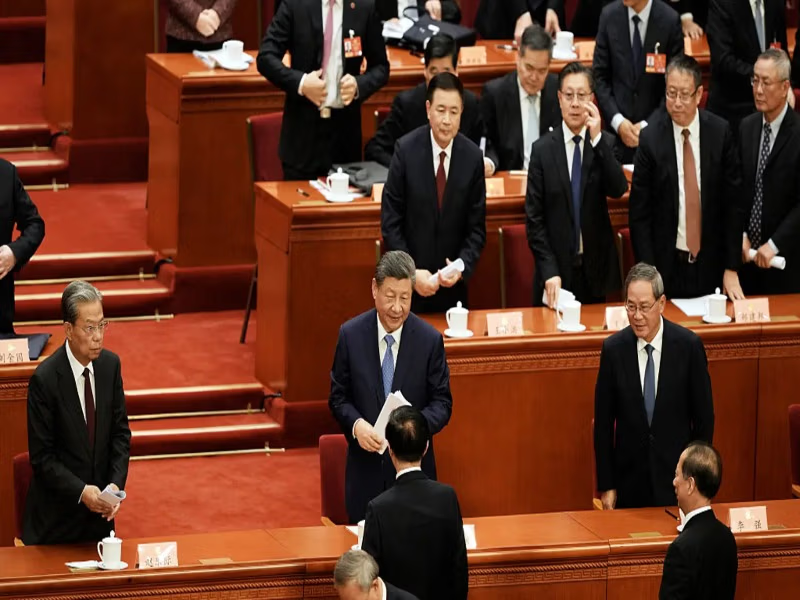
Chinese Premier Li Qiang, in the work report, indicated a plethora of issues facing the economy, including “dramatically changing international trade and economic environment” and “deep-rooted structural problem” that have weighed on consumption and investment growth.
Tianchen Xu, senior economist at Economist Intelligence Unit, said, “The growth target is quite realistic. It’s a further shift from a ‘number-first’ mindset towards a ‘quality-first’ one.”
Xu added, “Beijing doesn’t necessarily see high growth rates as a good thing, because it may incentivise local officials to exaggerate growth with white elephant projects — costly investment with little economic utility — and data manipulation.”
Beijing also aims to maintain the rate of urban unemployment, which was at 5.2 percent in the previous year, at a low rate of approximately 5.5 percent this year, and also to create 12 million urban jobs.
China to issue 1.3 trillion yuan ($188.5 billion) in ultra-long-term special treasury bonds in 2026, the same as last year, and allocated 250 billion yuan to assist the consumer goods trade-in program and another 300 billion yuan for capital replenishment at huge state-owned commercial banks.
According to the work report, the government has also planned to issue 4.4 trillion yuan of local government special-purpose bonds, again like last year, to fund major projects and ease the stress on local government debts.
“Government spending this year will continue to be fairly large in scale,” Li said in the work report, adding that increasing consumption and raising living standards must be a priority.
Xu stated that the comparatively small fiscal stimulus was also in line with the conservative growth target. Beijing made a commitment of keeping doing an “appropriately accommodative” monetary policy to enhance growth, which may include a possible reduction of interest rates and a reduced reserve requirement ratio.
Li said, “We will develop new and better structural monetary policy instruments, scale them up as needed, and refine the ways they are used.”
The country’s annual parliamentary meeting, known as the “Two Sessions,” opened on Wednesday with the opening ceremony of the Chinese People’s Political Consultative Conference, a top policy advisory body.
The NPC began its session on Thursday and has until March 12 to complete its annual meeting. The heads of the economic and financial ministries are likely to address journalists on Friday afternoon.
As China saw an economic growth of 5 percent last year, the nation has plunged into a fourth year of deflation amidst a collapse in real estate, low levels of consumer confidence, and local government debt. Retail sales increased 3.6 percent in 2025, and factory-gate deflation worsened, dropping 2.6 percent annually.
Fixed-asset investment fell 3.8 percent last year, the first annual drop in decades. The real estate drags deepened with investment in the sector down at 17.2 percent.
This parliament meeting follows several months of trade war with the U.S., the second-largest economy in the world, which saw the United States cutting off a year of global trade with the country, hastening its export diversification beyond America, into Europe and Southeast Asia.
Premier Li infrequently mentioned the economic effects of the U.S. tariff shock, indicating that fresh stimulus measures that were introduced last year had mitigated the impact.
The continuous war in the Middle East has also raised a question on the scheduled visit to China of U.S President Donald Trump later this month, where he was to be meeting with Chinese leader Xi Jinping to deliberate on a list of issues such as tariffs, export controls, and Taiwan.
China has attacked the U.S.-Israeli attacks on Iran, and it has demanded an immediate ceasefire and return to diplomacy. Recent days have seen Chinese Foreign Minister Wang Yi making phone calls with Iranian and Israeli counterparts and presenting China as an active participant in defusing the conflict.