
China’s consumer inflation in China experienced the largest increase in over three years, and an extended holiday enhanced spending, with a deflation in factory-gate prices becoming moderate.
China’s National Bureau of Statistics data reported on Monday that, beating economists’ forecasts for a 0.8 percent increase in a Reuters poll, the consumer price index surged 1.3 percent in February from the previous year.
According to LSEG data, the increase came after a 0.2 percent rise in January, marking the strongest rebound since January 2023. On a monthly basis, prices hiked up to 1 percent in February, above economists’ expectations for a 0.5 percent rise.
The official data compiled by Wind Information stated that the core CPI, which removes volatile food and energy prices, jumped 1.8 percent last month from a year earlier, matching the pace last seen in March 2019.
Zhiwei Zhang, president and chief economist at Pinpoint Asset Management, said in a note Monday, “The price hikes in the service sector during the Chinese New Year is stronger than market expected [and] whether this effect will be persistent beyond the holiday is not clear at this stage.”
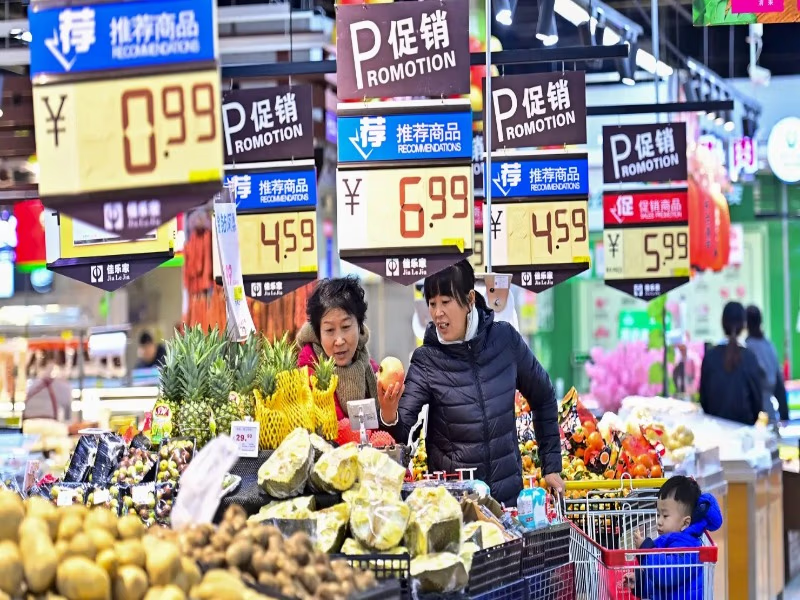
The official data indicated that service prices increased 1.1 percent last month compared to a year ago, adding 0.54 percentage points to the headline CPI, which is fueled by the demand for travel, pets, vehicle repair, movies, and dining services over the holiday.
The Lunar New Year holiday this year lasted between February 15 and 23, the longest in history, as compared to eight days between late January and the early period of this year.
The producer price index of China decreased by 0.9 percent over the year, contrary to the opinions of economists that the index was supposed to decline by 1.2 percent, the slowest pace of deflation in over a year signified that factory-gate prices were tentatively capped by the skyrocketing costs of metals and commodities.
Meanwhile, in a significant economic policy-setting meeting last week, China kept its annual consumer inflation target steady at “around 2%” for 2026.
It was the first time since 2025 with the lowest level since the Chinese policymakers tried to support domestic demand and curb the aggressive price war that was going on in most industries.
The inflation target is rather a ceiling than a target to be achieved. Consumer prices were also unchanged in 2025, but core inflation rose 0.7 percent as consumer confidence remained weak.
Beijing also reduced its target GDP growth this year to between 4.5 and 5 percent, the smallest target in recent history, since the early 1990s, as officials admitted ongoing deflationary pressures and increased geopolitical uncertainty.
Chinese officials added to domestic spending, allocating 250 billion yuan ($36.2 billion) in the 2025 fiscal budget to subsidize a consumer trade-in program, a reduction over 300 billion yuan in 2025, and a 100-billion-yuan government fund to aid consumer spending and private investment.
“The pace [of these stimulus measures] will remain incremental,” said Larry Hu, chief China economist at Macquarie, noting that while policymakers see weak consumption as a structural issue to be addressed, the need for “aggressive consumption stimulus is low” with exports and manufacturing seen to continue powering growth.
Hu said in a note on last Thursday, “The main swing factor is exports. If exports remain strong, policymakers may continue to tolerate weak domestic consumption. Conversely, if exports falter, they will step up domestic stimulus to defend the GDP target.”
The geopolitical tensions and the current conflict in the Middle East have caused the prices of gold jewelry and gasoline to increase in China by 6.2 percent and 3.1 percent in February, respectively.
Silver and gold refining factory-gate prices increased by 16.9 percent and 8.4 percent, and oil and gas extraction prices went up by 5.1 percent.
The Middle East conflict, which has not been easing much, could keep propelling the producer prices of China even in March, said Zhang, and a long conflict would run the risk of putting the global economy into stagflation.
Zhang said that China might be forced to adopt a stronger fiscal policy than its budget, which was revealed last week, in case the Middle East tensions do not dissipate in the second quarter.