
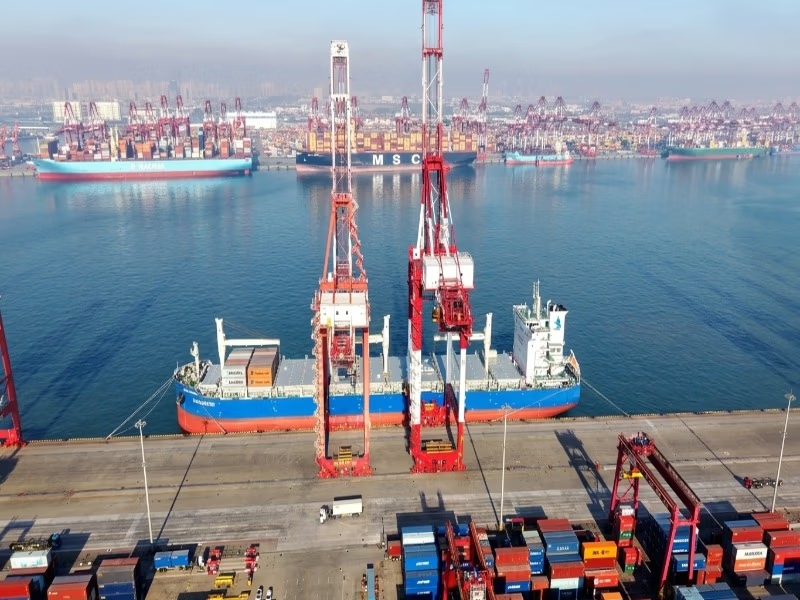
China’s trade surplus increased to the highest point in history during the combined January-February period, while exports hugely exceeded expectations, highlighting the resilience of the world’s second-largest economy amid trade tensions with the U.S.
China generally aggregates January and February trade data to regularize distortions related to the changing Lunar New Year holiday. The trade balance rose to $213.62 billion, compared with expectations of $179.6 billion.
Chinese exports have increased by 21.8 percent year-on-year in the January-February period, surpassing the forecasted growth of 7.1 percent, as reported by the economists polled by Reuters.
Customs data released on Wednesday also revealed that the imports increased by 19.8 percent in the initial two months, compared to a 6.3 percent increase that was expected to be increased.
Government data reported that while trade with the U.S. plummeted 16.9 percent to 609.71 billion yuan ($88.22 billion) compared with the same period the year before, trade with the EU jumped 19.9 percent to 998.94 billion yuan.
Trade with ASEAN also rose by 20.3 percent to 1.24 trillion yuan. The trade statistics follow the consumer inflation in China, which recorded its highest rise in more than three years, which was aided by the expenditure during a long holiday.
Zhiwei Zhang, President and Chief Economist at Pinpoint Asset Management, said in a note following the data release, the unexpected was partly due to the relatively late Lunar New Year holiday, which may have extended the year-on-year growth rate compared to last year. However, he added that it “probably cannot fully explain the surprise.”
Zhang noted that the high export performance and relatively modest growth target of Beijing in their yearly “Two Sessions” policy conferences indicate that further stimulus is unlikely in the near term.
During the “Two Sessions” policy meeting, Premier Li Qiang established a goal of GDP growth of 4.5-5 percent, the lowest level since the early 1990s.
China’s CPI increased by 1.3 percent in February compared to a year before and exceeded the expectation of economists that it would rise by 0.8 percent in a poll conducted by Reuters.
The growth, which improved after a 0.2 percent upsurge in January, was the highest recovery since January 2023. The statistics also arrived as the Chinese Premier Li Qiang admitted the effects of U.S tariffs as he gave his economic targets on Thursday at the “Two Sessions” meeting.
Since the U.S. President Donald Trump returned to the Oval Office in January 2025, the two countries have been engaged in a trade war, each imposing and removing tariffs on the products of the other in the course of 2025.
However, the relationship has improved following a meeting between Trump and Xi Jinping on the fringes of the APEC summit in Busan, South Korea, in October.
U.S. tariffs on Chinese goods currently remain at the global 10 percent level following the Supreme Court struck down of Trump’s tariffs enacted under the International Emergency Economic Powers Act.
Nevertheless, previous tariffs imposed under Section 301 of the Trade Act of 1974 and Section 232 of the Trade Expansion Act of 1962 still exist on certain products, up to 100 percent.
Business intelligence firm China Briefing said in February that “due to the multitude of existing duties, the effective tariff rate on many Chinese goods shipped to the US remains close to 30 percent – still the highest of any country.”