
Wars are often defined by clear objectives. But the current conflict between the United States and Iran is raising a different question. What exactly does Washington want to achieve?
Two weeks into the war, US air strikes continue to hit targets across Iran. Iran is responding with waves of missiles and drones. Global markets are watching closely as oil prices swing and geopolitical risks rise. Yet analysts say the ultimate goal of the military campaign remains unclear.
Statements from US President Donald Trump suggest multiple possible outcomes. These range from weakening Iran’s military to forcing regime change or negotiating a new deal. The shifting messaging has left policymakers and investors trying to understand what Washington’s real endgame might be.
Nearly 2,000 US strikes in Iran
More than two decades after the 2003 invasion of Iraq reshaped the Middle East, the United States has again entered a major regional conflict.
According to available data, US forces have struck nearly 2,000 targets in Iran since the war began. Several senior Iranian officials have been killed, including the country’s former supreme leader, Ali Khamenei, in Tehran.
Subsequent attacks have targeted nuclear facilities, civilian areas, and critical infrastructure such as oil refineries and a desalination plant.
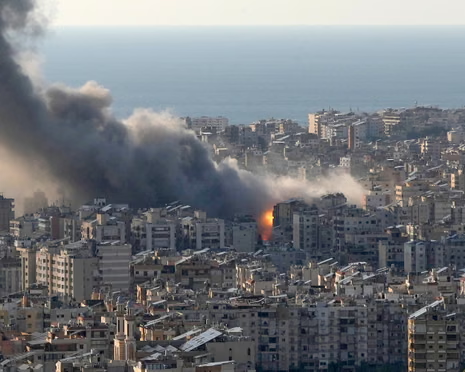
Iran has responded with large-scale retaliation. Tehran says it has launched hundreds of missiles and thousands of drones targeting Israel and several Gulf neighbours. Iranian officials say the attacks were aimed at US military bases, energy facilities, embassies, and civilian areas.
The human cost is mounting. More than 1,200 Iranians have been killed so far. Among them were more than 160 children who died when a school was bombed. Seven American soldiers have also died during the conflict.
Despite the scale of the war, analysts say Washington has not clearly defined how it intends to end the fighting.
Is regime change the real objective?
The war began on February 28 with strikes that killed Khamenei, who had led Iran for 37 years.
Although the Trump administration has not openly used the term regime change, experts believe the initial attacks were designed to destabilise Iran’s leadership.
“The objective of the strikes was instant capitulation of the regime and a popular uprising,” said Mustafa Hyder Sayed, executive director of the Pakistan-China Institute.
Muhanad Seloom, assistant professor of international politics and security at the Doha Institute for Graduate Studies, described the approach as an “unstated bet”.
That approach assumed “that removing the head and enough of the body will cause the system to either collapse or become so weakened that whatever emerges cannot restore Iran’s pre-war posture”, Seloom told Al Jazeera.
However, signs of a political collapse have not appeared.
Iran has already appointed a new supreme leader. The role has gone to Khamenei’s 56-year-old son, Mojtaba Khamenei.
“I believe it was a miscalculation on the part of Trump, because they didn’t expect and understand that Iran has the resilience and the staying power to fight a long, drawn-out war,” Sayed told Al Jazeera.
Trump offers deals while strikes continue
Since launching what Washington calls Operation Epic Fury, Trump’s public statements have alternated between negotiation and escalation.
Early in the conflict, he called on members of Iran’s Islamic Revolutionary Guard Corps to lay down their arms and surrender in exchange for immunity. He later urged Iranian diplomats to defect.
Those appeals have been rejected.
The IRGC has been leading Iran’s counteroffensive against the United States and Israel. Iranian diplomats also dismissed Trump’s offer in a public letter, saying they remain committed to representing the Islamic Republic.
“The IRGC has just pledged full obedience to the new supreme leader,” Seloom said. “Trump has designated them a terrorist organisation. Neither side has the political space for that conversation while the bombing continues.”
Destroying Iran’s military capability
Another objective repeatedly mentioned by the Trump administration is weakening Iran’s military power.
US and Israeli strikes have targeted ballistic missile infrastructure, manufacturing sites and naval assets. One strike reportedly hit an Iranian warship near Sri Lanka.
Both countries say they now control Iranian airspace.
Who will rule Iran?
Trump has also spoken about Iran’s political future.
After the February 28 air strikes, he addressed the Iranian public.
“To the great people of Iran, I say that the hour of freedom is at hand. When we are finished, take over your government. It will be yours to take,” he said.
Later, he suggested that someone inside Iran should lead a future government rather than Reza Pahlavi, the son of the former shah who lives in the United States.
However, Trump has also rejected Mojtaba Khamenei as Iran’s new leader and demanded influence over who replaces him.
On March 6 he wrote on Truth Social that there would be “no deal with Iran except UNCONDITIONAL SURRENDER”.
“There will be no deal with Iran except UNCONDITIONAL SURRENDER!” he wrote. He added that after surrender, “GREAT & ACCEPTABLE Leader(s)” must be selected.
Tehran has rejected those demands. Iranian officials say there will be no surrender, no negotiations during bombardment and no externally imposed leadership.
Other scenarios under discussion
Several other options have been discussed by analysts.
One involves Kurdish fighters attacking Iranian forces in the hope of triggering a wider uprising. The US maintains relationships with Kurdish groups in Iraq and has a military presence near Erbil.
However experts say such a move would be highly complex and could escalate regional tensions.
Another possibility is a US ground invasion. Iran’s foreign minister Abbas Araghchi has said the country is prepared for that scenario.
Trump has not ruled out deploying American troops. But Kamran Bokhari of the New Lines Institute for Strategy and Policy says domestic politics in the United States could make that difficult.
Trump campaigned on an anti war message. The legacy of US wars in Iraq and Afghanistan still shapes public opinion.
Israel’s strategic calculation
For Israel, the conflict with Iran has deeper strategic roots.
Mahjoob Zweiri, director of the Gulf Studies Center at Qatar University, told Al Jazeera that Israel sees the war as part of a broader effort to reshape the regional balance of power after the October 7, 2023, Hamas attack.
“What Israel plans to do is essentially use October 7 as a pretext for what they call reshaping the Middle East, exactly as the United States did after 9/11,” he said.
“Israel wants to eliminate, marginalise and defeat every potential player capable of challenging it, including Iran.”
A negotiated settlement may still emerge
Some analysts believe a negotiated settlement may ultimately become the most realistic outcome.
Andreas Krieg, associate professor of security studies at King’s College London, said Washington could seek a coercive settlement with elements of Iran’s leadership.
“Washington could still be open to an understanding with elements of the regime, including IRGC linked actors, if those actors were willing to protect the state while conceding enough on missiles, nuclear restrictions and regional behaviour to let Trump claim success,” he told Al Jazeera.
Sayed also believes Trump may eventually pursue a deal.
“Trump is quite a pragmatist. He would like to make a deal, declare that the US has achieved its goals, and conclude the war,” he said.
“He can redefine victory, say Khamenei has been killed, the armed forces destroyed, and end it. A ground invasion would mean a political setback domestically and losing the midterms.”
For now, the conflict continues with no clear roadmap for how it ends. And as the war expands, the geopolitical and economic consequences continue to grow.