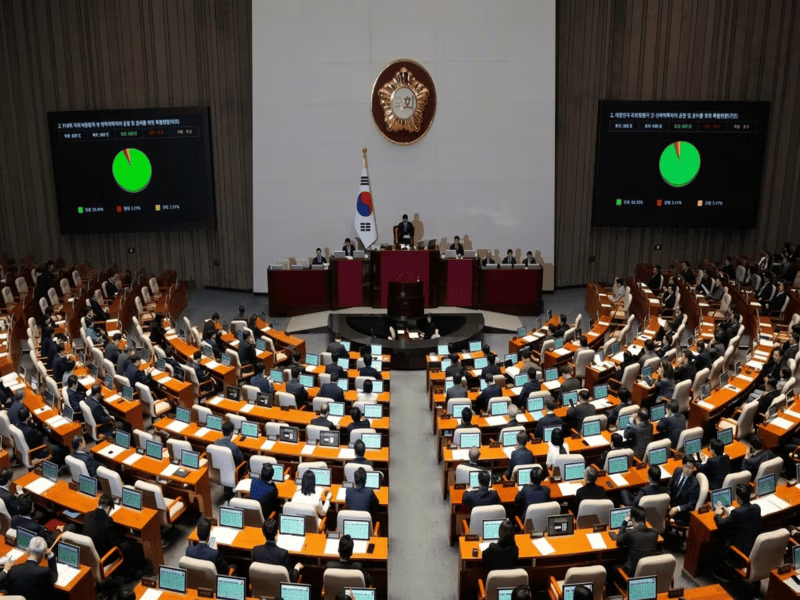
South Korea’s parliament on Thursday passed a special bill to establish a state-run investment corporation to manage Seoul’s planned $350 billion investment into the U.S.
Government officials had requested lawmakers to quickly enact the contested bill, which will be submitted in November, as irregularities mount for the country’s trade-dependent economy, rattled by President Donald Trump’s protectionist swing and now concerning of the fallout from his war on Iran.
The bill was passed several hours after the Trump administration exerted greater influence on trade partners by initiating a new investigation into manufacturing operations in other nations, among them China and U.S. allies South Korea and Japan, which would lead to new import taxes in case U.S. officials find their practices to be unfair.
Trump and his crew have indicated that they want to use new tariffs to recover revenue that they had lost when the U.S Supreme Court ruled against his broad-based tariffs as declared by the emergency powers.
China protested against the action and demanded that there be negotiations to settle any disagreements. Foreign Ministry spokesperson Guo Jiakun said in Beijing, “China opposes any form of unilateral tariff measures. Tariff wars and trade wars serve no one’s interests.”
The South Korean law, which passed 226-8, recommends the formation of a state corporation to administer the guaranteed U.S. investments, including examining and choosing projects through the feedback given by South Korean and U.S. trade authorities.
Others in Congress opposed the bill even before the vote, complaining about new Trump trade investigations and the role the war in the Middle East has played in helping reveal the weakness of the South Korean economy, dependent on exports and dependent on imported fuel.
Son Sol, a member of the minor opposition Progressive Party, said, “We cannot be the money machine Trump wants us to be.” She explained that the bill does not provide the legislature with adequate authority to scrutinize and disapprove of investments that may endanger South Korean business or public interests.
After several months of strained talks, South Korea signed a pact with the United States in November to inject $200 billion into U.S. semiconductor and other high-tech sectors, and another 150 billion into shipbuilding. In return, Washington reduced tariffs reciprocally on Seoul by 25-15 percent.
The agreement, which was preceded by a breakthrough in a summit meeting between Trump and South Korean President Lee Jae Myung, also limits South Korean investments to $20 billion a year to safeguard the foreign currency reserves of the country.
Lee’s liberal Democratic Party initiated the legislation in November but faced resistance from opposition lawmakers worried about the economic impact.
The legislative holdup frustrated Trump, who in January threatened to raise tariffs on South Korean autos, pharmaceuticals, and other goods back to 25 percent, putting pressure on the opposition to move the bill forward.