

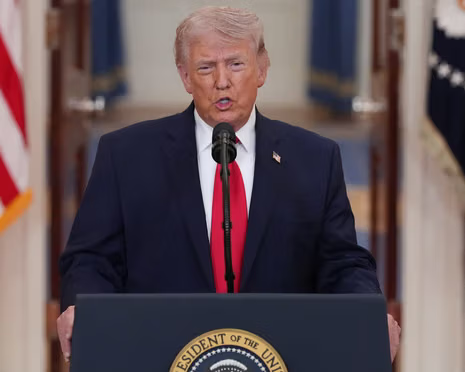
U.S. President Donald Trump has proposed a federal budget that sharply expands military spending while reducing funding for domestic programs, signaling a clear shift in fiscal priorities as global tensions intensify.
The plan outlines a defense allocation of approximately $1.5 trillion for fiscal year 2027, setting a new benchmark for U.S. military spending. The increase reflects a broader push to strengthen national security capabilities, with funding expected to support advanced weapons systems, force readiness, and infrastructure modernization.
The scale of the proposal marks a significant departure from recent budgets, underscoring the administration’s emphasis on defense amid heightened geopolitical uncertainty.
At the same time, the plan calls for a 10 percent reduction in non-defense discretionary spending. The proposed cuts would affect a wide range of domestic programs, including education, environmental initiatives, housing, and public health services.
The approach effectively reallocates resources from domestic priorities toward military investment, framing defense spending as a central pillar of economic and strategic policy.
Officials have argued that the increase is necessary to address a more complex global security environment, where competition among major powers and regional conflicts are placing new demands on military capabilities.
Critics, however, have raised concerns about the potential impact on social infrastructure and long-term economic resilience. Reductions in domestic spending, they argue, could weaken support systems at a time when inflation and cost pressures remain elevated.
The proposal also brings fiscal considerations into focus. Expanding defense expenditure while cutting domestic programs reflects an effort to manage budget constraints, but it does little to address broader concerns around deficits and national debt.
As with previous budgets, the proposal now moves to Congress, where it is expected to face extensive debate. Lawmakers will ultimately determine the final allocation, with negotiations likely to center on balancing security priorities with domestic investment.
Beyond the immediate policy implications, the budget signals a broader strategic direction. The administration is positioning defense not only as a security imperative, but also as a driver of industrial activity and technological advancement.
Whether that shift proves sustainable will depend on how effectively the U.S. can balance competing priorities in an environment where economic, political, and geopolitical pressures are increasingly intertwined.