
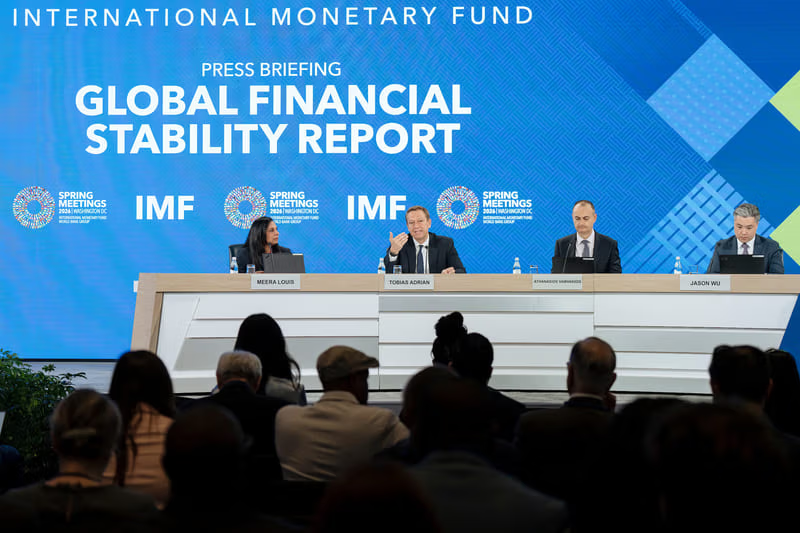
The IMF’s global growth outlook has been revised lower, as the International Monetary Fund warned that the world economy is already drifting toward a more adverse trajectory amid prolonged disruptions in energy markets linked to the Middle East conflict.
The IMF outlined three possible paths for the global economy in its latest assessment, ranging from a relatively contained slowdown to a near-recession scenario, depending on how the conflict evolves and its impact on oil supply through critical routes such as the Strait of Hormuz.
IMF Growth Forecast 2026:
— IMF (@IMFNews) April 14, 2026
🇺🇸 US: 2.3%
🇩🇪 Germany: 0.8%
🇫🇷 France: 0.9%
🇮🇹 Italy: 0.5%
🇪🇸 Spain: 2.1%
🇬🇧 UK: 0.8%
🇯🇵 Japan:0.7%
🇨🇦 Canada: 1.5%
🇨🇳 China: 4.4%
🇮🇳 India: 6.5%
🇷🇺 Russia: 1.1%
🇧🇷 Brazil: 1.9%
🇲🇽 Mexico: 1.6%
🇸🇦 Saudi Arabia: 3.1%
🇳🇬 Nigeria: 4.1%
🇿🇦… pic.twitter.com/hs7T3ebF1v
In its baseline, or “reference,” scenario, the IMF assumes a short-lived disruption, with oil prices moderating in the second half of 2026 and averaging around $82 per barrel for the year. Even under this relatively optimistic view, uncertainty remains elevated.
However, officials acknowledged that current conditions are already moving closer to a more adverse scenario. IMF chief economist Pierre-Olivier Gourinchas said ongoing energy disruptions and the absence of a clear resolution to the conflict are increasing the likelihood of weaker global growth.
Under this intermediate scenario, oil prices hover near $100 per barrel, dragging global growth down to around 2.5 percent, a sharp slowdown from 3.4 percent recorded in 2025.
The most severe scenario presents a more concerning outlook. In that case, oil prices could rise to an average of $110 per barrel in 2026 and $125 in 2027, pushing the global economy close to recession territory. The IMF noted that growth has fallen below 2 percent only a handful of times in recent decades, typically during major global crises.
A sustained energy shock would also complicate the inflation outlook. Higher oil prices could reignite inflationary pressures, forcing central banks to maintain tighter monetary policy for longer or even raise interest rates further, despite slowing economic activity.
At the same time, the IMF indicated that central banks may tolerate short-term energy-driven inflation if it proves temporary, thereby easing policy conditions amid weakening growth, provided inflation expectations remain anchored.
Regional impacts are expected to vary significantly. The euro zone is projected to face a more pronounced slowdown due to its sensitivity to energy costs, while emerging markets, which are often more dependent on imported fuel, are likely to see a sharper decline in growth.
China’s growth outlook has been slightly trimmed due to higher commodity prices, although policy support and easing trade tensions offer some offset. Japan’s growth remains subdued but stable, with expectations of gradual monetary tightening.
India stands out as a relatively bright spot, with growth forecasts revised slightly higher to around 6.5 percent for both 2026 and 2027, supported by domestic momentum and easing trade headwinds.
The Middle East and Central Asia region, at the center of the conflict, is expected to bear the brunt of the economic impact, with growth projections sharply reduced due to infrastructure damage and disruptions to energy exports.
The IMF also cautioned governments against broad-based fiscal responses such as fuel subsidies or price controls, warning that such measures could strain public finances and create unintended distortions in energy markets. Instead, it recommended targeted and temporary support for vulnerable populations.
The broader message from the IMF is one of increasing fragility. While the global economy has shown resilience in recent years, the combination of geopolitical tensions, energy shocks, and tightening financial conditions is narrowing the margin for stability.
As the situation evolves, the balance between inflation control and growth support is likely to become more difficult for policymakers to maintain, raising the risk of a more pronounced slowdown if current disruptions persist.