

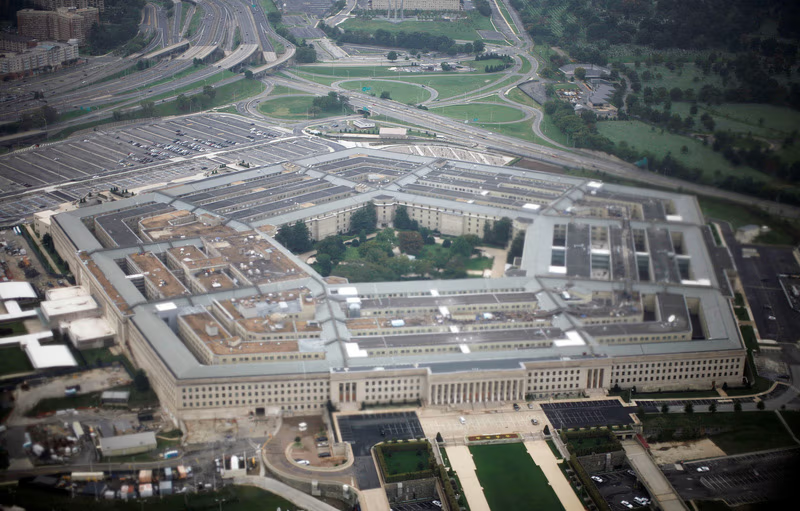
The US Department of Defense is accelerating its artificial intelligence ambitions, announcing agreements with seven major technology companies to deploy advanced AI capabilities across its most secure, classified networks.
The move signals a strategic shift by the Pentagon to broaden its AI ecosystem, reducing reliance on a narrow group of providers while scaling access to cutting-edge tools across military operations.
Among the companies selected are OpenAI, Google, Microsoft, Amazon Web Services, NVIDIA, and SpaceX, as well as emerging player Reflection. These firms will be integrated into the Pentagon’s Impact Level 6 and 7 environments, which handle some of the most sensitive classified data.
The expansion comes as the Defense Department scales its internal AI platform, GenAI.mil, which has already been adopted by more than 1.3 million personnel within just five months of operation. The rapid uptake highlights how central AI has become to defence strategy, from intelligence analysis to operational planning.
Notably absent from the new agreements is Anthropic, a prominent AI start-up that has recently been at odds with the Pentagon over usage safeguards. Earlier this year, the company was designated a supply-chain risk, effectively barring its tools from use across the Department of Defense and its contractors.
Officials have cited concerns about guardrails and the potential misuse of advanced AI capabilities as a key reason for the exclusion. The debate reflects a broader tension within the defence sector, balancing rapid technological adoption with the need for strict control over how AI systems are deployed in sensitive environments.
At the same time, there are signs that the stance could evolve. Donald Trump recently indicated that Anthropic is “shaping up” in the administration’s view, suggesting the possibility of a future reversal of its blacklisting.
The Pentagon’s approach underscores an emerging doctrine: diversify AI suppliers while maintaining tight oversight of security and ethical use. By bringing multiple vendors into classified environments, the Department of Defense aims to foster competition, accelerate innovation, and reduce dependency risks.
For global markets, including the UAE and broader Middle East, the development reinforces how AI is increasingly intertwined with national security and critical infrastructure. Governments in the region are also investing heavily in sovereign AI capabilities, often partnering with global technology firms while navigating similar questions around regulation, control, and data security.
As the Pentagon deepens its AI integration, the message is clear: artificial intelligence is no longer experimental in defence, it is becoming foundational.