
In the story of Dubai’s transformation from a trading outpost to a global business hub, a few names stand out for having quietly shaped its commercial DNA. Vasu Shroff is one of them.
His journey, which began with a dhow ride from Mumbai to Sharjah in 1960, mirrors the evolution of the UAE itself. Armed with little more than a suitcase of textile samples and an instinct for opportunity, Shroff stepped into a market that had yet to take form. There were no structured retail districts, no global supply chains, and few guarantees. What existed instead was possibility.
From a small textile shop in Bur Dubai, he built something far more enduring than a business. He built trust. In an era before formalized contracts and digital systems, relationships were currency. Shroff understood this early, establishing trading networks across the Gulf that would later become the backbone of the Regal Group.
Over time, that foundation scaled into a diversified enterprise spanning the UAE, Saudi Arabia, Oman, Qatar, and India. Wholesale textile distribution, premium retail showrooms, and institutional supply chains formed the core. But what distinguished Shroff was not just scale; it was structure.
He moved early into vertical integration through Regal Stitch, converting fabric into finished garments and capturing greater value across the chain. Long before diversification became a corporate buzzword, he expanded into technology through Regal Tech in the late 1980s, entering satellite communication and enterprise solutions ahead of market maturity.
Real estate followed as a parallel pillar, with strategic investments across Dubai that provided both stability and long-term appreciation. This multi-pronged approach reflected a disciplined philosophy: build assets, not just revenue.
Financially, the results were significant. Estimates over the years placed his personal net worth between $500 million and $600 million, while the Regal Group evolved into a multi-billion-dollar enterprise. Yet, those who interacted with him often recall something else entirely.
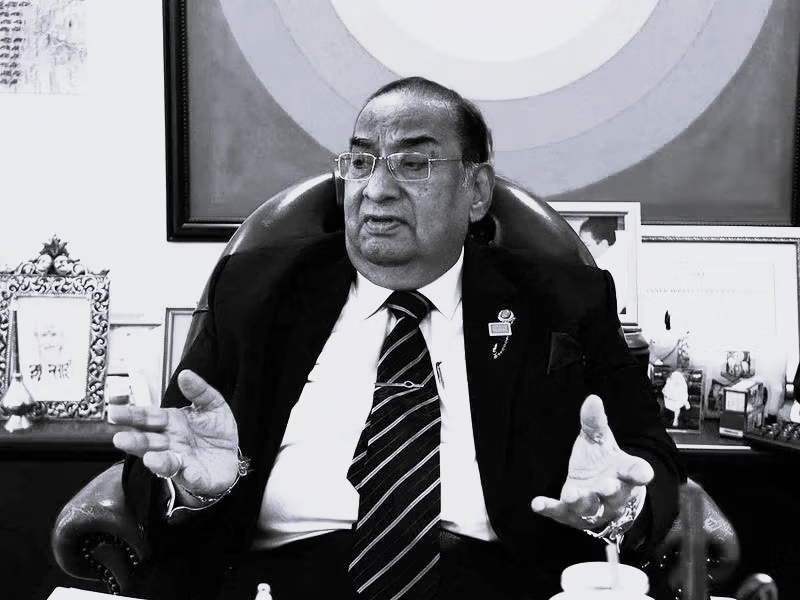
There was no overt display of success. No unnecessary noise. Just clarity of thought and a quiet confidence built over decades of execution. A meeting at his office in Dubai’s Regal Building in early 2020 left a lasting impression, not for grandeur, but for simplicity.
Beyond business, Shroff played a defining role in shaping the social fabric of the Indian community in the UAE. Institutions such as The Indian High School and India Club became pillars of identity and continuity for generations of expatriates. His contributions extended beyond commerce into community building, a legacy that continues to resonate.
In many ways, his story offers a blueprint for entrepreneurs navigating today’s global markets. Scale does not come from speed alone, but from trust built over time. Longevity depends on the ability to adapt across cycles. And true legacy lies not just in wealth creation, but in the institutions and ecosystems one leaves behind.
From arriving by boat to becoming widely known as the “Textile King of Dubai,” Vasu Shroff built more than an empire. He built a narrative that reflects the very ethos of the UAE’s rise, where ambition meets resilience, and where quiet conviction often speaks the loudest.