

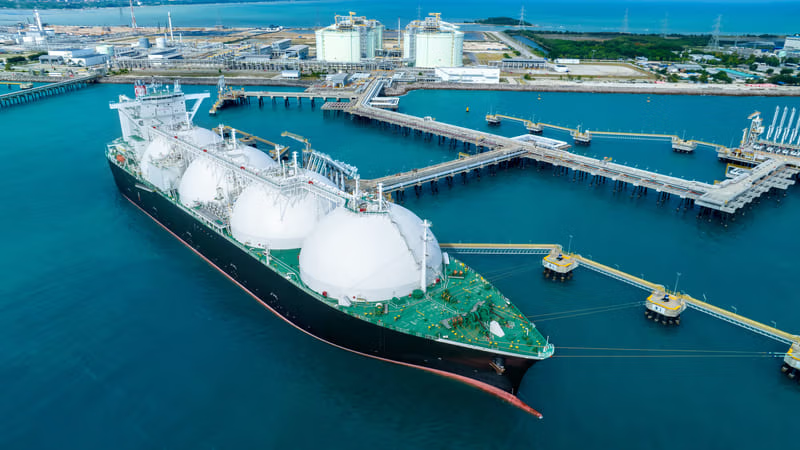
US liquefied natural gas (LNG) exports to Asia rose sharply in April, highlighting the growing role of American producers in meeting global energy demand and balancing international supply flows.
Preliminary ship-tracking data from LSEG shows that nearly a quarter of US LNG exports were directed to Asian markets during the month, marking a notable rise compared to earlier in the year. The increase reflects stronger demand from key importers as they continue to secure supply amid evolving global market conditions.
Shipments to Asia have climbed steadily in recent months, rising from approximately 970,000 metric tons in February to 1.99 million metric tons in March, and reaching 2.71 million metric tons in April. The trend underscores the flexibility of US LNG exporters, who can redirect cargoes in response to shifting regional demand.
Asian spot LNG prices remained relatively elevated in April. The Japan Korea Marker benchmark averaged $17.92 per million British thermal units (mmBtu), slightly lower than March levels but still above Europe’s TTF benchmark, which averaged $15.34 per mmBtu. The price differential reflects continued strength in demand in Asian markets.
On the supply side, gas flows to US LNG export terminals reached a record 18.8 billion cubic feet per day during April, indicating robust operational capacity across export facilities. Despite this, total LNG exports eased slightly to 10.97 million metric tons in April from a record 11.7 million metric tons in March, largely due to fewer days in April and some cargo-loading delays.
A key milestone during the month was the first LNG shipment from the Golden Pass terminal, a joint venture between QatarEnergy and ExxonMobil. The initial cargo was delivered to Belgium, marking the start of operations at a facility expected to play a larger role in future export volumes.
Europe remained the largest destination for US LNG, receiving 6.14 million metric tons, or just under 56 percent of total shipments in April. This reflects the region’s continued reliance on LNG imports as part of its diversified energy strategy.
Other markets also contributed to demand. Egypt imported approximately 710,000 metric tons of US LNG during the month, while Latin America received around 500,000 metric tons. A shipment to South Africa highlighted the expanding geographic reach of US exports.
Market activity remained dynamic, with several cargoes still in transit or awaiting final buyers, illustrating the fluid nature of global LNG trade.
Overall, the April data points to sustained demand for LNG and the increasing importance of flexible supply sources. As global energy markets continue to evolve, exporters’ ability to respond quickly to regional demand shifts is expected to remain a key factor shaping trade flows.