
Abu Dhabi Airports showcased the growing scale of its logistics and free zone ecosystem at Make it in the Emirates 2026, as its commercial free zone arm signed new agreements to strengthen trade, manufacturing, and supply chain connectivity across the UAE.
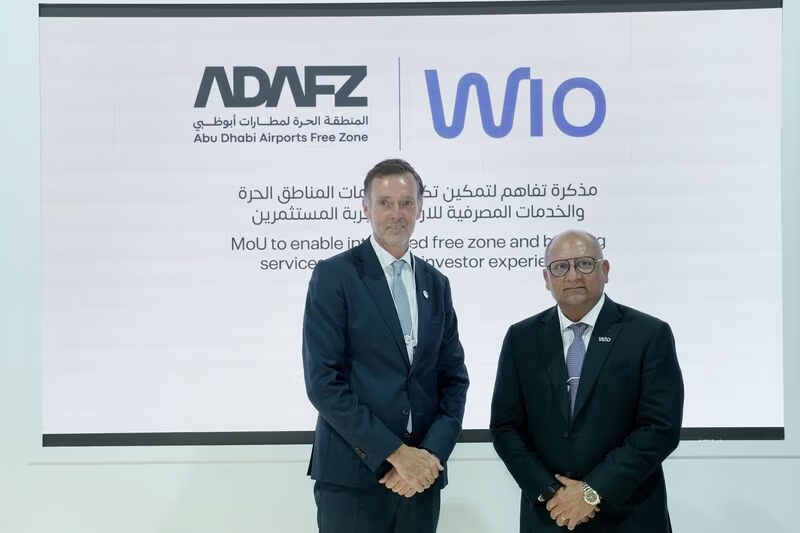
Abu Dhabi Airports Free Zone announced partnerships with Wio Bank and Abu Dhabi Food Hub during the event, reinforcing its strategy to position Abu Dhabi as a major regional logistics and industrial hub.
The agreements focus on improving financial onboarding for free zone businesses and strengthening the regional food supply chain infrastructure.
Under the agreement with Wio, the digital bank will provide streamlined account-opening and onboarding services for ADAFZ clients and become a preferred banking partner for companies operating in the free zone ecosystem.
Meanwhile, the partnership with Abu Dhabi Food Hub aims to develop a central consolidation capability integrating logistics, infrastructure, and trade systems to improve the movement of food products across regional and international markets.
ADAFZ currently manages approximately 90 million square meters of land across three strategic airport locations: Zayed International Airport, Al Bateen Executive Airport, and Al Ain International Airport.
The free zone network hosts more than 500 registered companies and offers an integrated logistics infrastructure, including bonded corridors, airside and landside access, and regulations that allow full foreign ownership and zero import or export duties.
Among ADAFZ’s key assets are the Al Falah logistics hub, spanning 8.3 million square meters near Zayed International Airport, and the 800,000-square-meter Logistics Park, which already houses global logistics operators including FedEx and DHL.
The company is also developing the East Midfield Cargo Terminal, a 90,000-square-meter facility expected to handle up to 1.5 million tonnes of cargo annually once fully operational in 2027.
Ahmed Juma Al Shamisi said the emirate’s accelerating non-oil growth is being supported by long-term investments in infrastructure and trade ecosystems.
“We offer a strategically integrated ecosystem that connects manufacturers, logistics operators, and global supply chains to one of the world’s fastest-growing travel and trade hubs,” he said.
The announcement comes as Abu Dhabi continues recording strong non-oil economic growth. According to the Statistics Center Abu Dhabi, the emirate’s non-oil trade grew 36 percent in 2025, while transport and storage activity rose 13.8 percent during the third quarter.
The first half of the year also recorded nearly a 50 percent increase in new business setups, highlighting Abu Dhabi’s expanding role within global trade and industrial supply chains.
Industry analysts say logistics infrastructure, cargo connectivity, and free zone ecosystems are becoming increasingly important competitive advantages as Gulf economies seek to diversify beyond hydrocarbons and attract investment in advanced manufacturing.
The latest agreements further reinforce Abu Dhabi’s ambition to position itself as a regional gateway linking industrial production, logistics, trade finance, and global distribution networks.
With inputs from WAM