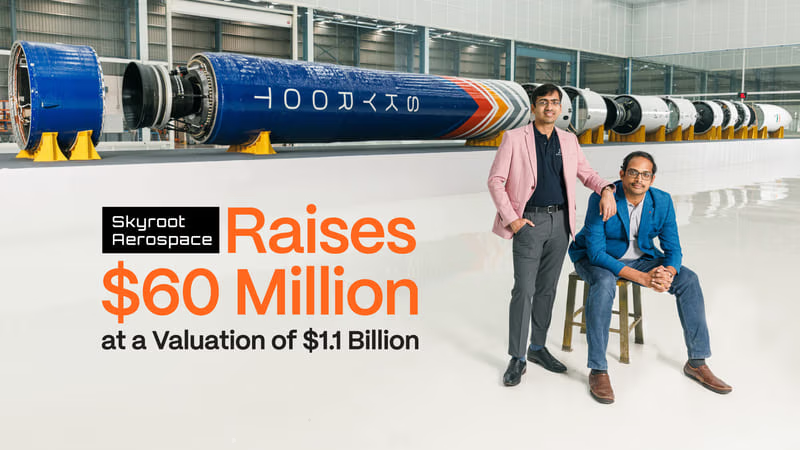
Skyroot Aerospace has become India’s first space-tech unicorn after raising approximately $60 million in fresh funding, marking a major milestone for the country’s rapidly expanding private space industry.
The Hyderabad-based startup crossed a valuation of roughly $1.1 billion following the funding round, becoming India’s first privately held space technology company to achieve unicorn status.
The latest round included participation from investors such as Singapore sovereign wealth fund GIC, Sherpalo Ventures, the founders of Greenko Group, and Arkam Ventures, according to multiple reports.
The milestone comes as Skyroot prepares for the launch of Vikram-1, which could become India’s first privately developed orbital rocket. The company is targeting a launch from Satish Dhawan Space Centre in the coming weeks.
Skyroot previously made headlines in 2022 after successfully launching Vikram-S, India’s first privately built rocket to reach space.
Founded in 2018 by former ISRO scientists Pawan Kumar Chandana and Naga Bharath Daka, the company has emerged as one of the leading players in India’s fast-growing commercial space ecosystem.
The fresh capital is expected to support Vikram-1 launches, manufacturing expansion, infrastructure development, and the scaling of launch-vehicle technologies.
The development reflects the broader transformation of India’s space sector following government reforms that opened private participation in launch services, satellite manufacturing, and space infrastructure.
Industry analysts say investor interest in Indian space startups has accelerated sharply in recent years as the country positions itself as a lower-cost alternative within the global commercial space economy.
India’s private space industry has expanded rapidly since the establishment of IN-SPACe, the government-backed regulatory body designed to facilitate private-sector access to ISRO’s infrastructure and launch capabilities.
Alongside Skyroot, companies such as Pixxel and AgniKul Cosmos have also attracted growing international investor interest across satellite imaging, launch systems, and aerospace manufacturing.
According to industry estimates, India’s space economy is projected to expand significantly over the next decade as demand rises globally for satellite launches, Earth observation services, and space-based communications infrastructure.
Skyroot’s unicorn milestone is also being viewed as a symbolic moment for India’s startup ecosystem, demonstrating growing investor confidence in deep-tech and advanced engineering sectors traditionally dominated by government agencies.