In a striking fusion of technology and spirituality, South Korea has introduced its first humanoid robot monk, offering a glimpse into how artificial intelligence is beginning to intersect with centuries-old religious traditions.
The robot, named Gabi, made its public debut at Jogyesa Temple ahead of Buddha’s Birthday celebrations, participating in a Buddhist precept ceremony traditionally reserved for human followers.
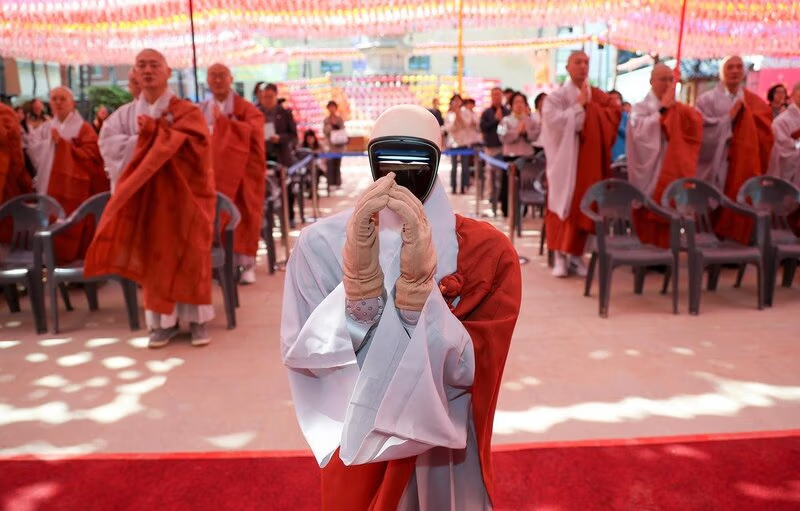
Standing 130 centimeters tall and dressed in traditional grey-and-brown Buddhist robes, Gabi stood before senior monks with folded hands, bowed respectfully during rituals, and pledged devotion to Buddhism before worshippers and media cameras.
South Korea's first humanoid robot monk made its debut at Jogye Temple in Seoul, ahead of Buddha's birthday. Gabi, the 130-centimeter-tall robot, wore a traditional grey-and-brown Buddhist robe and stood before monks as it pledged to devote itself to Buddhism pic.twitter.com/NDzDANRkhl
— Reuters (@Reuters) May 6, 2026
The ceremony was organized by the Jogye Order, the country’s largest Buddhist sect, which described the initiative as an exploration of how technology could coexist with spiritual life and cultural tradition.
Gabi received a Dharma name during the ceremony, combining references to Siddhartha, the Buddha’s birth name, and the Korean word for mercy. Monks also adapted traditional rituals specifically for the robot, replacing certain symbolic practices with modern alternatives better suited to a machine.
The debut comes at a time when South Korea is rapidly expanding investment in humanoid robotics and artificial intelligence. The country launched the K-Humanoid Alliance last year, bringing together robotics firms, universities, and technology companies with ambitions to become a global leader in humanoid robotics by 2030.
While Gabi’s appearance has drawn global attention for its novelty, it also reflects a broader conversation across Asia about the role of AI in religion, education, and emotional engagement.
Japan has already experimented with robotic Buddhist figures, including Mindar, an android preacher introduced at Kyoto’s Kodaiji Temple in 2019. Designed to deliver sermons and explain Buddhist teachings, Mindar became an early example of how robotics could be integrated into religious outreach.
Unlike industrial or service robots, religious humanoids occupy a more symbolic and philosophical space, raising questions about authenticity, spirituality, and whether machines can meaningfully participate in human cultural practices.
For Buddhist institutions facing aging populations and declining participation among younger generations, technology is increasingly being viewed as a tool for engagement rather than replacement.
Reports suggest that Gabi is expected to participate in upcoming Buddha’s Birthday events and lantern parades alongside other robotic Buddhist figures, reinforcing the Jogye Order’s efforts to modernize its outreach while maintaining traditional symbolism.
The development also highlights Asia’s growing leadership in humanoid robotics, as countries such as South Korea, Japan, and China accelerate efforts to integrate AI-powered machines into everyday life.
Whether viewed as a spiritual experiment, cultural statement, or technological showcase, Gabi’s debut underscores how artificial intelligence is increasingly moving beyond factories and offices into spaces once considered deeply and exclusively human.