

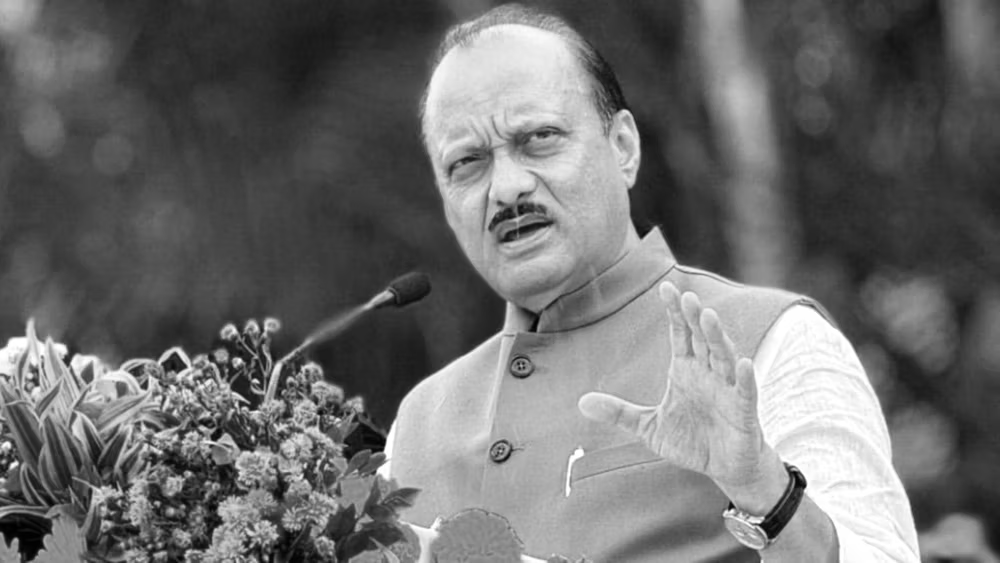
Ajit Anantrao Pawar (1959–2026) was one of India’s most consequential state-level leaders, whose influence extended well beyond Maharashtra’s political boundaries. Known for his command over public finance, infrastructure planning, and regional development, Pawar played a critical role in shaping policies that impacted India’s broader economic trajectory. His sudden death in a plane crash on 28 January 2026 has drawn attention not only in India but also among the Indian diaspora and business community in the UAE, many of whom followed his policy decisions closely.
Early Roots And Entry Into Public Life
Born in the Ahmednagar district of Maharashtra, Ajit Pawar emerged from a background rooted in cooperative institutions and rural enterprise. These cooperatives, especially in sugar, dairy, and agriculture, have historically played a major role in Maharashtra’s economy and continue to influence trade, employment, and capital flows that matter to overseas investors and Non-Resident Indians.
Pawar entered national politics briefly in the early 1990s before focusing his career on state governance, where his long-term impact would be felt most strongly.
A Key Figure In State Finance And Economic Planning
For global observers and overseas Indians, Ajit Pawar was best known as Maharashtra’s finance steward. Over multiple terms as Finance Minister, he presented several state budgets that prioritised industrial expansion, infrastructure creation, and investment-friendly policies.
Maharashtra, home to Mumbai, India’s financial capital, remains a major destination for foreign direct investment, including capital flows from the Gulf region. Policies shaped during Pawar’s tenure helped strengthen industrial corridors, logistics networks, and urban infrastructure, factors closely tracked by UAE-based investors with exposure to Indian real estate, manufacturing, and financial markets.
Longest-Serving Deputy Chief Minister
Ajit Pawar holds the distinction of being Maharashtra’s longest-serving Deputy Chief Minister, having served across different political coalitions and administrations. This continuity gave him an unusual degree of institutional knowledge and administrative control, particularly over economic portfolios.
For international businesses and overseas Indians, such continuity often translates into policy predictability, a key consideration when evaluating long-term investments and partnerships in India.
Infrastructure And Regional Connectivity
Infrastructure was a recurring theme in Pawar’s policy focus. He was closely associated with large-scale transport, irrigation, and urban development initiatives aimed at improving regional connectivity and productivity.
Projects linked to airports, highways, and industrial zones in western India were seen as enablers for trade and logistics, indirectly supporting India’s commercial ties with global hubs such as Dubai. Improved connectivity between Indian production centres and international markets remains a critical factor for exporters, logistics firms, and supply-chain operators based in the UAE.
Engagement With Industry And Cooperative Institutions
Ajit Pawar maintained strong ties with cooperative institutions and industry bodies, particularly in agriculture-linked sectors. These sectors are highly relevant to UAE-based Indian entrepreneurs involved in food processing, agri-trade, and commodity exports.
His approach blended grassroots economic activity with large-scale policy planning, reinforcing the link between rural production and global markets.
Political Transitions And Strategic Relevance
In later years, Pawar navigated complex political realignments, reflecting the evolving nature of India’s coalition politics. While political dynamics remained domestic, the outcomes influenced economic governance in one of India’s most commercially significant states.
For global observers, including Indian professionals in the Middle East, these transitions were closely watched for their potential impact on the investment climate and regulatory continuity.
Legacy And Wider Impact
Ajit Pawar’s legacy lies in his sustained focus on economic management, infrastructure-led growth, and institutional governance. While he remained a regional leader by designation, his decisions affected sectors and markets with national and international linkages.
His passing marks the end of an era in Maharashtra politics, but his influence on fiscal planning and development strategy will continue to shape policy discussions. For the Indian diaspora in the UAE, his career serves as a reminder of the far-reaching economic implications of state-level leadership in India.