

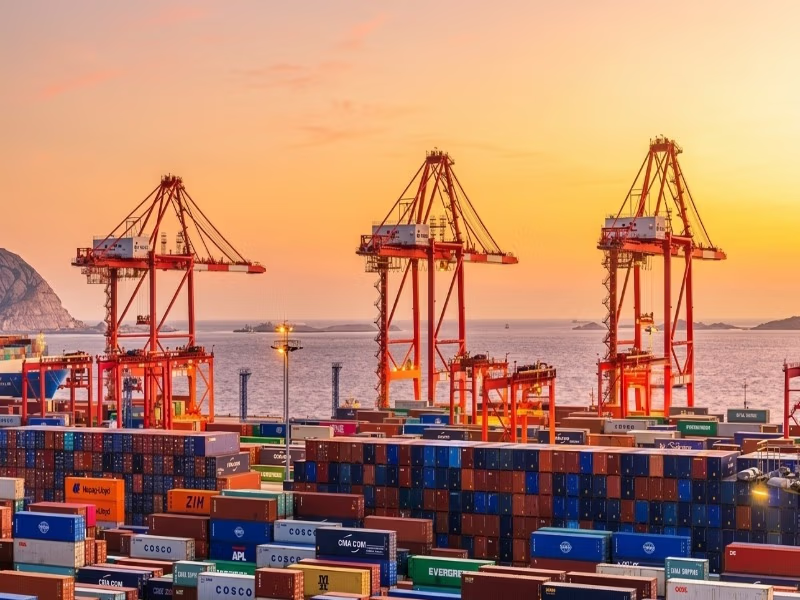
Official data indicated that container handling at Saudi ports increased by 20.89 percent year-on-year in February to 667,882 twenty-foot equivalent units.
According to a statement by the Saudi Ports Authority, also known as Mawani, the transshipment containers also experienced an increase of 28.09 percent on a yearly basis, with 155,325 TEUs recorded in the same month.
UK-based maritime journal Lloyd’s List reported that Saudi Arabia positioned 15th globally in container handling in 2024, as a sign of its growing role as a logistics hub.
The expansion is also in line with the National Logistics Strategy of the Kingdom that seeks to expand the contribution of the sector to gross domestic product to 10 percent by 2030, just as proper port operations are expected to place Saudi Arabia as a logistics hub in three continents.
The newly released statement said, “The number of incoming containers increased by 26.18 percent to reach 272,210 TEUs compared to 215,735 TEUs in the same period last year, while the number of outgoing containers increased by 11.54 percent to reach 240,347 TEUs compared to 215,485 TEUs last year.”
It stated, “The number of vehicles increased by 17.69 percent to reach 92,369 vehicles, compared to 78,482 vehicles last year. Similarly, maritime traffic recorded an increase of 13.06 percent to reach 1,385 ships, compared to 1,225 ships last year. Ports received 837,548 head of livestock, an increase of 19.99 percent compared to 698,035 head of livestock in the same period last year.”
The data indicated that the passenger numbers dropped 6.82 percent year-on-year to 86,567 in February. It also revealed that total tonnage processed, including general cargo, solid bulk cargo, and liquid bulk cargo, increased by 9.22 percent each year to 18.15 million tonnes in February.
The total general cargo was 880,377 tonnes, liquid bulk cargo was 13.40 million tonnes, and solid bulk cargo was 3.86 million tonnes.
The statement added, “The increase in the number of containers handled contributes to several economic benefits, as it enhances trade, stimulates industries and sectors related to maritime transport, promotes the growth of tourism, maritime activity, and associated services, supports supply chains, and contributes to achieving food security for the Kingdom, in line with the objectives of the National Transport and Logistics Strategy to consolidate Saudi Arabia’s position as a global logistics hub.”
The ports in the Kingdom recorded a year-on-year growth rate of 2.01 percent in January, with the number of containers handled in the month to 738 111 TEUs. Transshipment containers reached an increment of 22.44 percent to 184,019 TEU over the same period of time.